FATHER'S DAY AT THE EDGE OF SPACE: Would you like to send your dad to the Edge of Space? He can't go, but his picture can. Using a suborbital helium balloon, the students of Earth to Sky Calculus will fly the image of your choice to 120,000 ft and photograph it against the curved limb of the Earth. The returned photo (example) makes a great Father's Day gift. The flight fee is $49.95, and profits support student research. Contact Dr. Tony Phillips for details.

CME IMPACT: As predicted, a CME hit Earth's magnetic field on June 7th. The glancing blow at approximately 16:30 UT could spark minor geomagnetic storms in the hours ahead. High-latitude sky watchers should be alert for auroras. Aurora alerts: text, voice
The CME that arrived today left the sun on June 4th. It was propelled into space by a magnetic filament erupting from the sun's SE limb. This movie from the Solar and Heliospheric Observatory shows the ejecta from the explosion:

The CME hurtled away from the sun at 520 km/s or 1.2 millon mph. It was not, however, squarely Earth-directed. Today's impact was only a glancing blow, hence the expectation of minor geomagnetic activity. Stay tuned for updates.
Realtime Space Weather Photo Gallery
INCREASING CHANCE OF FLARES: NOAA forecasters have boosted the odds of an M-class flare on June 7th to 35%. To see why, click on the image below, and pay close attention to the circled regions:

During the past 48 hours, three large sunspot groups have materialized. Nearly invisible on June 5th, now the active regions are peppered with dark cores larger than Earth. All three regions have unstable magnetic fields that pose a threat for significant eruptions.
The greatest threat comes from sunspot AR2080. Its 'beta-gamma-delta' magnetic field harbors energy not only for medium M-class flares, but also for powerful X-flares. Because AR2080 is centrally located on the solar disk, any flares this weekend will likely be Earth-directed. Solar flare alerts: text, voice
Realtime Space Weather Photo Gallery
NOCTILUCENT CLOUDS INTENSIFY: NASA's AIM spacecraft saw the first wispy noctilucent clouds (NLCs) of the 2014 summer season on May 24th. Since then NLCs have begun to intensify around the Arctic Circle and descend to lower latitudes. On June 6th, Noel Blaney spotted a bank of the electric-blue clouds over Bangor, Northern Ireland:
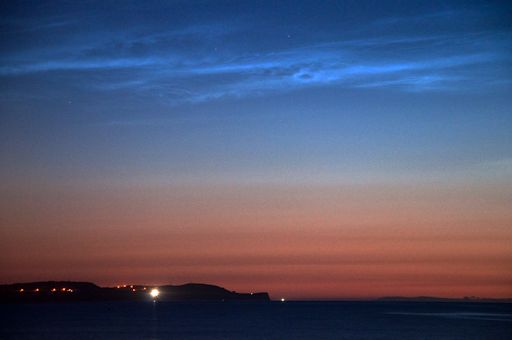
"I witnessed this nice early-season noctilucent cloud display over Belfast Lough at 2am," says Blaney. "These are my first proper images of NLCs!"
A few hours later, Lance Taylor saw more NLCs over Edmonton, Alberta. "This was my first sighting of the season - and I have been watching for them for the past two weeks now," he says.
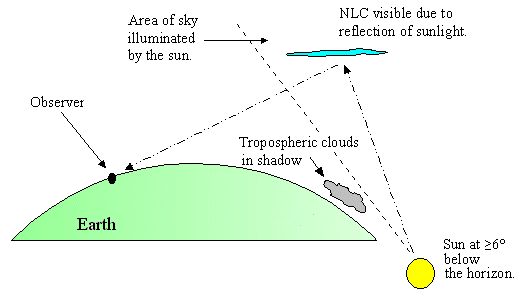
Seeded by meteor smoke and boosted by the climate-change gas methane, noctilucent clouds have been spreading beyond the Arctic. In recent years, they have been sighted as far south as Colorado and Utah. Observing tips: Look west 30 to 60 minutes after sunset when the Sun has dipped 6o to 16o below the horizon. If you see luminous blue-white tendrils spreading across the sky, you may have spotted a noctilucent cloud.

Realtime Space Weather Photo Gallery