FATHER'S DAY AT THE EDGE OF SPACE: Would you like to send your dad to the Edge of Space? He can't go, but his picture can. Using a suborbital helium balloon, the students of Earth to Sky Calculus will fly the image of your choice to 120,000 ft and photograph it against the curved limb of the Earth. The returned photo (example) makes a great Father's Day gift. The flight fee is $49.95, and profits support student research. Contact Dr. Tony Phillips for details.

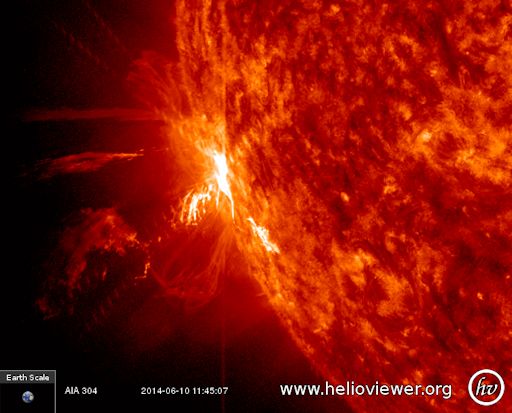
DOUBLE X-FLARE: Forecasters expected an X-flare today, and the sun complied. The source, however, was unexpected. A new sunspot (AR2087) suddenly emerging from behind the sun's southeastern limb erupted twice, producing an X2.2-flare at 11:42 UT and an X1.5-flare at 12:52. This extreme ultraviolet image from the Solar Dynamics Observatory shows the first blast:
X-rays and UV radiation from the double flare created a wave of ionization in Earth's upper atmosphere, altering the normal propagation of radio transmissions over Europe. Rob Stammes recorded the sudden ionospheric disturbance (SID) from his laboratory in Lofoton, Norway: data. Preliminary coronagraph images from NASA's STEREO probes show a bright CME emerging from the blast site, traveling mostly away from the sun-Earth line. No strong impacts are expected.
Before today's double-eruption, forecasters had been keeping a wary eye on sunspot complex AR2080/AR2085. Almost directly-facing Earth, those two sunspots have 'delta-class' magnetic fields that harbor energy for X-flares. The emergence of sunspot AR2087 on the southeastern limb adds another potent source to the mix. Solar activity is high, and likely to remain so in the days ahead. Solar flare alerts: text, voice
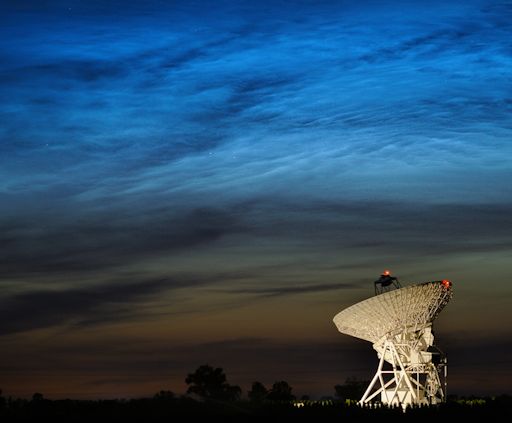
SPECTACULAR NOCTILUCENT CLOUDS: Last night, June 9th, a spectacular display of noctilucent clouds (NLCs) swept across central Europe. "I have waited three years to take a picture like this," says Piotr Majewski who witnessed the apparition at the Torun Centre for Astronomy in Poland:
"Noctilucent cloud season has officially begun here in Poland," says Marek Nikodem. "I saw the same display from the town of Szubin, and it was spectacular." Nikodem is a long-time photographer of noctilucent clouds. Last night he framed a nest of storks backlit by electric blue.

Noctilucent clouds are a summertime phenomenon. NASA's AIM spacecraft spotted the first NLCs of the 2014 season on May 24th, and they have been intensifying ever since. Long ago, NLCs were confined to the Arctic, but in recent years they have been sighted as far south as Colorado and Utah. Some researchers think the increasing visibility is a sign of climate change. Whatever the cause, sky watchers should be alert for NLCs as northern summer unfolds.

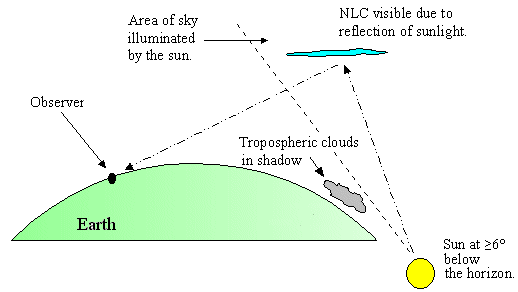
Observing tips: Look west 30 to 60 minutes after sunset when the Sun has dipped 6o to 16o below the horizon. If you see luminous blue-white tendrils spreading across the sky, you may have spotted a noctilucent cloud.
Realtime Space Weather Photo Gallery