GEOMAGNETIC UNREST: NOAA forecasters estimate a 20% to 30% chance of minor geomagnetic storms on June 16-17 in response to a high-speed solar wind stream. Auroras may be difficult to see, however, because of glare from the waning full Moon. Aurora alerts: text, voice
SUMMER SUN HALO: Around the northern hemisphere, sky watchers are starting to report a rainbow-colored sun halo that appears almost-exclusively during summer: the circumhorizon arc. "I saw one on June 13th. It was very bright," says Michail Anastasio, who snapped this picture from the cockpit of a plane flying 20,000 feet over Singapore:
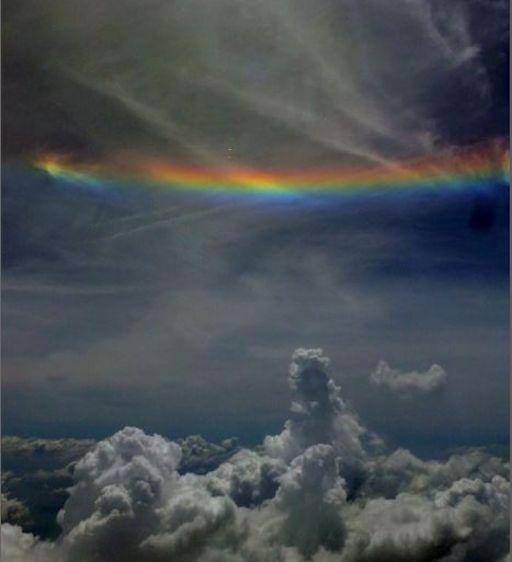
Nicknamed the "fire rainbow" because of its fiery rainbow colors, this apparition in fact has nothing to do with either fire or rainbows. It is caused by sunlight refracting through plate-shaped ice crystals in cirrus clouds. The geometry of the refraction requires that the sun be high in the sky (above 58o), which explains why this is a summertime phenomenon.
June and July are the best months to see circumhorizon arcs. Look for them circling the horizon sometimes in patches, sometimes not, always brightly decorated with pure and well separated prismatic colors. You'll know it when you see it. More examples may be found in the realtimme photo gallery:
Realtime Space Weather Photo Gallery
SOLAR ACTIVITY: With several active sunspots rotating over the sun's western limb, solar activity is quieting. The departure, however, is a riot. J. P. Brahic sends this picture of activity in the exit zone from Uzès, France:

Brahic took the picture through cirrus clouds using a 9 inch solar telescope, and he inserted an image of Earth for scale. The dark cores of the departing sunspots are about the size of our planet, and the surrounding tangle of magnetic filaments could swallow Earth with room to spare.
These sunspots are leaving behind at least one region still capable of major flares: AR2087 is almost directly facing Earth and it has a 'beta-gamma' magnetic field that harbors energy for M-class eruptions. Any flares from AR2087 today would hit Earth head on. Aurora alerts: text, voice
Realtime Space Weather Photo Gallery