GEOMAGNETIC UNREST: A minor G1-class geomagnetic storm circled the poles during the late hours of June 18th in response to unsettled conditions in the solar wind. NOAA forecasters estimate a 10% chance of more storming on June 19th as Earth exits the solar wind disturbance. Aurora alerts: text, voice
HALOBACTERIA SURVIVE COSMIC RADIATION: On June 7th, the students of Earth to Sky Calculus sent two vails of halobacteria to the edge of space onboard a suborbital helium balloon. The tiny astronauts set a new high-altitude ballooning record for their species: 116,000 feet. Students have just finished reducing data from the flight and found that the bacteria were exposed to cosmic radiation levels 29 times higher than Earth-normal:

The bacteria were also frozen solid. During their passage through the tropopause temperatures plummeted to -60 degrees C. They experienced this blast of cold twice, once during the ascent and again as they were parachuting back to Earth.
Amazingly, the bacteria survived. Students have incubated the microbes, and they are now growing happily in a Petri dish at +40 degrees C. The next step in the experiment is to compare the flown microbes with a control sample to determine what fraction survived the combined thermal-radiation shock of their trip to the edge of space.
Astrobiologsts have long wondered if halobacteria, a terrestrial extremophile with a special talent for shielding itself from UV radiation, could survive on the planet Mars. The Earth to Sky experiments suggest the answer may be "yes." Stay tuned for updates from the Petri dish.
See also: "Teen launch balloons to the Edge of Space" from the LA Times
Realtime Space Weather Photo Gallery
MESOSPHERIC GRAVITY WAVES: Some thunderstorms are so powerful that they create ripples in the atmosphere 80 to 90 km high, at the edge of space itself. In satellite images such storms look like a giant atmospheric bulls-eye. It turns out these ripples are also visible from the ground. Amateur astronomer Thomas Ashcraft recently photographed them over New Mexico:
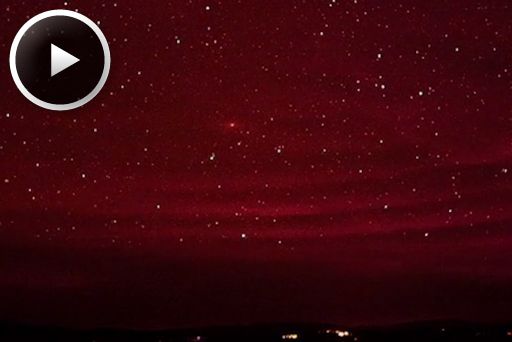
"Over the past few years I have been photographing sprites above distant thunderstorms using an infrared camera," says Ashcraft. "It turns out that the strong thunderstorm systems that generate sprites often also perturb the mesosphere and create gravity waves."
"This near infrared image from June 05, 2014, shows gravity waves above a powerful thunderstorm cell over western Kansas. The storm was about three hundred miles away from my observatory so the thunderstorm itself was below my horizon."
"There are many stills of this phenomenon but not many time-lapses that show their complex motions," he says. "I posted a movie extract of the storm on vimeo. Note also the sprites that pop up sporadically."
"The mesosphere is not well studied and it holds much Nature yet to be discovered," concludes Ashcraft. "To me it is a vast ecological zone full of beauty."
Realtime Space Weather Photo Gallery
SUMMER SUN HALO: Around the northern hemisphere, sky watchers are starting to report a rainbow-colored sun halo that appears almost-exclusively during summer: the circumhorizon arc. "I saw one on June 13th. It was very bright," says Michail Anastasio, who snapped this picture from the cockpit of a plane flying 20,000 feet over Singapore:
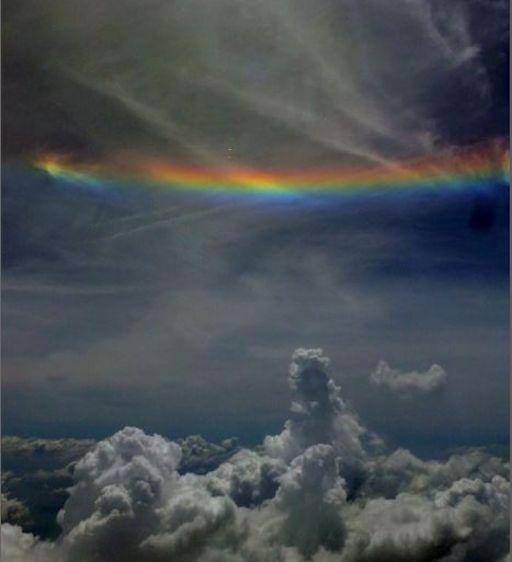
Nicknamed the "fire rainbow" because of its fiery rainbow colors, this apparition in fact has nothing to do with either fire or rainbows. It is caused by sunlight refracting through plate-shaped ice crystals in cirrus clouds. The geometry of the refraction requires that the sun be high in the sky (above 58o), which explains why this is a summertime phenomenon.
June and July are the best months to see circumhorizon arcs. Look for them circling the horizon sometimes in patches, sometimes not, always brightly decorated with pure and well separated prismatic colors. You'll know it when you see it.