LAST DAY OF NORTHERN SPRING: The season are changing. On June 21st, the sun will reach its northernmost point in the sky, +23.5 degrees above the celestial equator, marking the onset of summer in the north and winter in the south. Today is the last day of northern spring. Happy solstice!
ELECTRIC-BLUE SUMMER CLOUDS: Noctulicent clouds (NLCs) are a phenomenon of summer. Ironically, that is when the top of Earth's atmosphere is cold enough to form ice crystals around meteor smoke--the "stuff" of NLCs. So, you know the summer solstice is near when the late-night sky starts to look like this:
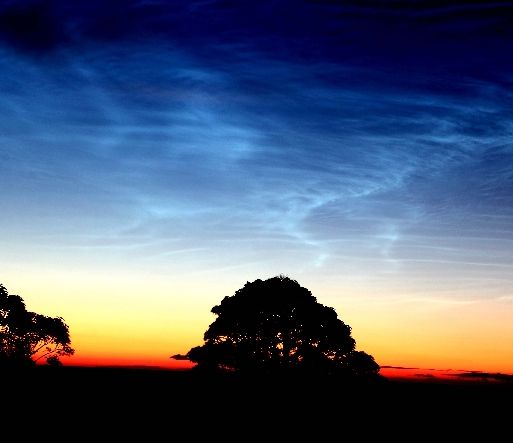
"This fine display of NLCs lasted a number of hours and was visible all across Northern Ireland," says photographer Andy McCrea of Bangor in County Down. "These pictures were taken around 3am on June 20th."
Mark McKenna of Maghera, Northern Ireland, also saw the cloud's signature electric-blue ripples. "Last night's absolutely spectacular noctilucent cloud display was one of the best I have seen in years," he says. "The NLCs were beautiful, glowing vivid white then blue. Of note were the graceful whirls, herringbone, sharp bands and lacunosus holes, the NLCs were even casting shadows onto other NLC forms."
Long ago, NLCs were confined to the Arctic, but in recent years they have been sighted as far south as Colorado and Utah. Some researchers think the increasing visibility is a sign of climate change. Whatever the cause, sky watchers should be alert for NLCs as northern summer unfolds.

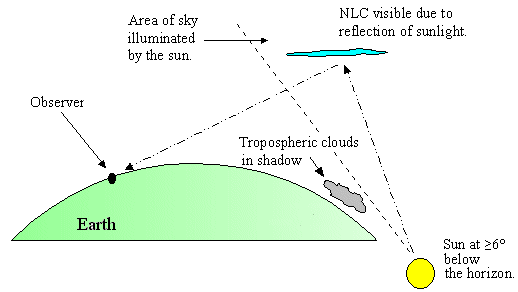
Observing tips: Look west 30 to 60 minutes after sunset when the Sun has dipped 6o to 16o below the horizon. If you see luminous blue-white tendrils spreading across the sky, you may have spotted a noctilucent cloud.
CORKSCREW ERUPTION: A dark magnetic filament on the sun erupted during the late hours of June 19th. While one end of the filament remained connected to sunspot complex AR2093-AR2094, the other end corkscrewed wildly through the sun's atmosphere. Click to view the eruption, and keep an eye on the circled region:
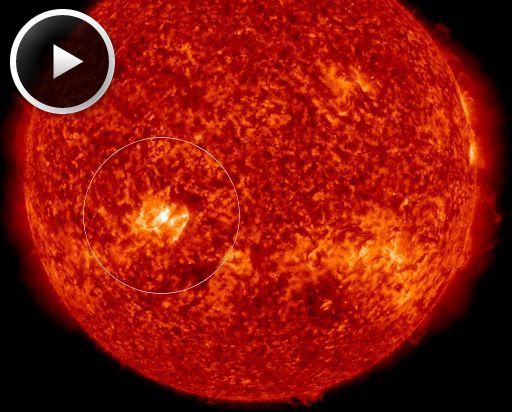
The corkscrewing filament hurled much of itself into space. Both of NASA's STEREO probes and the Solar and Heliospheric Observatory recorded a CME emerging from the blast site: movie. A preliminary analysis suggests an expansion velocity near 600 km/s or 1.3 million mph. That may sound fast, but it is merely typical for a CME. The expanding cloud could deliver a glancing blow to Earth's magnetic field in a few days, possibly sparking a minor geomagnetic storm. Aurora alerts: text, voice

Realtime Space Weather Photo Gallery
HALOBACTERIA SURVIVE COSMIC RADIATION: On June 7th, the students of Earth to Sky Calculus sent two vials of halobacteria to the edge of space onboard a suborbital helium balloon. The tiny astronauts set a new high-altitude ballooning record for their species: 116,000 feet. Students have just finished reducing data from the flight and found that the bacteria were exposed to cosmic radiation levels 29 times higher than Earth-normal:

The bacteria were also frozen solid. During their passage through the tropopause temperatures plummeted to -60 degrees C. They experienced this blast of cold twice, once during the ascent and again as they were parachuting back to Earth.
Amazingly, the bacteria survived. Students have incubated the microbes, and they are now growing happily in a Petri dish at +40 degrees C. The next step in the experiment is to compare the flown microbes with a control sample to determine what fraction survived the combined thermal-radiation shock of their trip to the edge of space.
Astrobiologsts have long wondered if halobacteria, a terrestrial extremophile with a special talent for shielding itself from UV radiation, could survive on the planet Mars. The Earth to Sky experiments suggest the answer may be "yes." Stay tuned for updates from the Petri dish.
See also: "Teen launch balloons to the Edge of Space" from the LA Times
Realtime Space Weather Photo Gallery