CHANGING SEASONS: Today is the June solstice. At 6:51 a.m. EDT on June 21st, the sun reached its northernmost point on the celestial sphere (+23.5o declination) marking the start of summer and the longest day of the year in the northern hemisphere. In the southern hemisphere, it is the start of winter and the shortest day. Either way, happy solstice!
SPACE WEATHER BUOY TAKES SELFIE: Assisted by the students of Earth to Sky Calculus, spaceweather.com has been launching a series of Space Weather Buoys to measure cosmic radiation in the stratosphere. A buoy consists of an insulated payload (a.k.a. K-Mart lunchbox) bristling with sensors and cameras, carried aloft by a suborbital helium balloon. On the latest flight, June 19th, the payload took a selfie. Here it is flying 95,000 feet above Earth's surface:

The "SelfieCam" was designed by high school student Carson Reid. It is shown here held up for inspection by launch team member Amelia Koske-Phillips.

The goal of the ongoing experiment is to determine how radiation levels change during solar and geomagnetic storms, and how those changes affect the ozone layer. During each flight, the buoy gathers a complete radiation profile starting at the launch site in California's Eastern Sierras and extending up to 100,000+ feet. Such data are of interest to aviators, entrepreneurs in the emerging space tourism industry, and researchers of the ozone layer. Selfies are a visual bonus.
A complete data set will be released in Oct. 2014 when the student scientists will have collected a full year of radiation measurements, spanning all four seasons and a variety of space weather conditions. Stay tuned.
See also: "Teens launch balloons to the Edge of Space" from the LA Times
THE FIRST MAGNETIC STORM OF SUMMER? NOAA forecasters have finished analyzing the CME described below in the news item "Corkscrew Eruption." The cloud is expected to sideswipe Earth's magnetic field on June 22nd with a 35% chance of minor geomagnetic storms in response to the impact. High-latitude sky watchers should be alert for auroras. Aurora alerts: text, voice
CORKSCREW ERUPTION: A dark magnetic filament on the sun erupted during the late hours of June 19th. While one end of the filament remained connected to sunspot complex AR2093-AR2094, the other end corkscrewed wildly through the sun's atmosphere. Click to view the eruption, and keep an eye on the circled region:
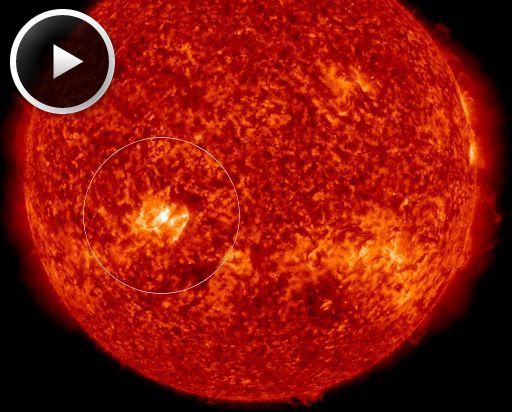
The corkscrewing filament hurled much of itself into space. Both of NASA's STEREO probes and the Solar and Heliospheric Observatory recorded a CME emerging from the blast site: movie. A preliminary analysis suggests an expansion velocity near 600 km/s or 1.3 million mph. That may sound fast, but it is merely typical for a CME. The expanding cloud could deliver a glancing blow to Earth's magnetic field on June 22nd, possibly sparking a minor geomagnetic storm. Aurora alerts: text, voice

Realtime Space Weather Photo Gallery
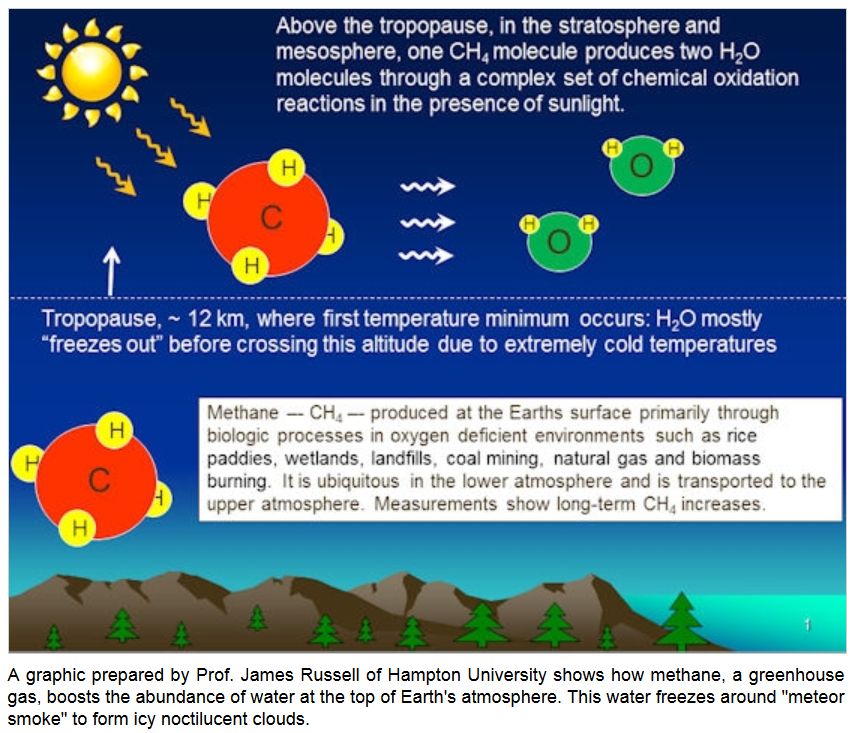
ELECTRIC-BLUE SUMMER CLOUDS: Noctulicent clouds (NLCs) are a phenomenon of summer. Ironically, that is when the top of Earth's atmosphere is cold enough to form ice crystals around meteor smoke--the "stuff" of NLCs. So, you know the summer solstice has arrived when the evening sky starts to look like this:
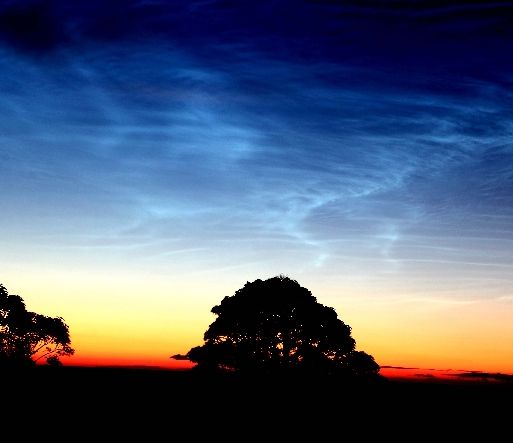
"This fine display of NLCs lasted a number of hours and was visible all across Northern Ireland," says photographer Andy McCrea of Bangor in County Down. "These pictures were taken around 3am on June 20th."
Mark McKenna of Maghera, Northern Ireland, also saw the clouds' signature electric-blue ripples. "This absolutely spectacular noctilucent cloud display was one of the best I have seen in years," he says. "The NLCs were beautiful, glowing vivid white then blue. Of note were the graceful whirls, herringbone, sharp bands and lacunosus holes, the NLCs were even casting shadows onto other NLC forms."
Long ago, NLCs were confined to the Arctic, but in recent years they have been sighted as far south as Colorado and Utah. Some researchers think the increasing visibility is a sign of climate change. Whatever the cause, sky watchers should be alert for NLCs as northern summer unfolds.
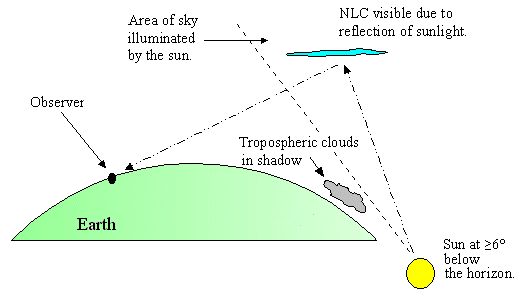
Observing tips: Look west 30 to 60 minutes after sunset when the Sun has dipped 6o to 16o below the horizon. If you see luminous blue-white tendrils spreading across the sky, you may have spotted a noctilucent cloud.