CME IMPACT, MORE TO COME: Arriving about a day later than expected, a CME hit Earth's magnetic field on June 23rd at 2300 UT. The impact did not spark a geomagnetic storm. A second CME following close behind could, however, push the geomagnetic field over the threshold into storm conditions. A glancing blow is expected during the early hours of June 24th. Aurora alerts: text, voice
AMATEUR ASTRONOMERS PHOTOGRAPH A DAMOCLOID: If you've never heard of a "damocloid", don't feel bad; even many professional astronomers don't know what they are. However, there are at least 50 of them moving through the Solar System. Named after protoptype object 5335 Damocles, a damocloid is an asteroid that follows a comet-like orbit. In fact, many damacloids turn out to be comets when, without warning, they suddenly sprout a tail. The latest to make this transformation is damacloid 2013 UQ4. Michael Jäger photographed it on June 23rd from his backyard observatory in Stixendorf, Austria:
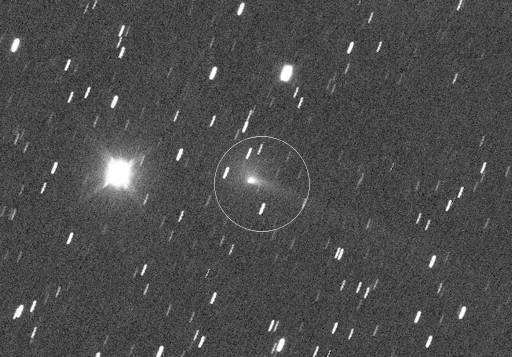
Discovered in the fall of 2013 by Catalina Sky Survey, 2013 UQ4 at first appeared to be a dark asteroid. On May 7, 2014, however, astronomers noticed a fuzzy atmosphere surrounding object's formerly-inert core. Barely two months later, it has sprouted a tail and is undeniably a comet. 2013 UQ4 swung by the sun in early June, a warm encounter that boosted the activity of its apparently icy nucleus. 2013 UQ4 is expected to brighten to binocular visibility (7th magnitude) by July 10th when it flies by Earth approximately 29 million miles (0.3 AU) away.
Want to see a damacloid with your own eyes? Sky maps and observing tips may be found in this article by David Dickinson.
TRIPLE RING AROUND THE SUN: Regular sky watchers are accustomed to seeing rings of light around the sun. Called "ice halos," they form when sunlight shines through ice crystals in high clouds. Usually these rings appear one at a time. On June 21st, Jun Lao of Mason, Ohio, saw three at once:
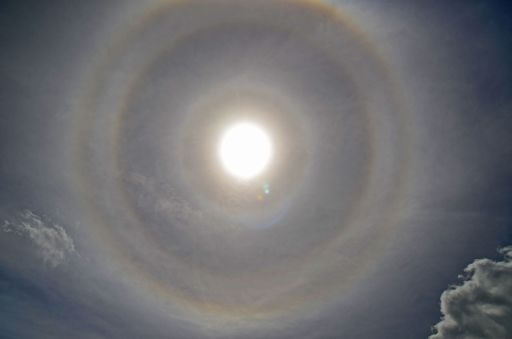
"It was about 4 p.m. EDT in the greater Cincinnati area when I imaged what I first thought was a regular halo, but was surprised to see three concentric halos!" says Lao. "The sky had a light cloud layer, and I suspect these multiple halos were caused by pyramidal ice crystals."
Indeed, they were. Ordinary sun halos are produced by crystals shaped like pencils and flat plates. On rare occasions, however, the sky fills with pyramidal crystals. They look like two pyramids glued together, base-to-base. The pyramid-tips are sometimes truncated, and sometimes the two pyramids are separated by an intervening prism section, creating 18 different variations with up to 20 sides. Such a complicated crystalline form can produce multiple halos during the same display.
These multiple halos are sometimes called "odd-radius halos." However, as atmospheric optics expert Les Cowley points out, "Odd radius halos are perhaps not so 'odd' or rare as usually thought. Make a point of routinely searching for them."
Realtime Space Weather Photo Gallery
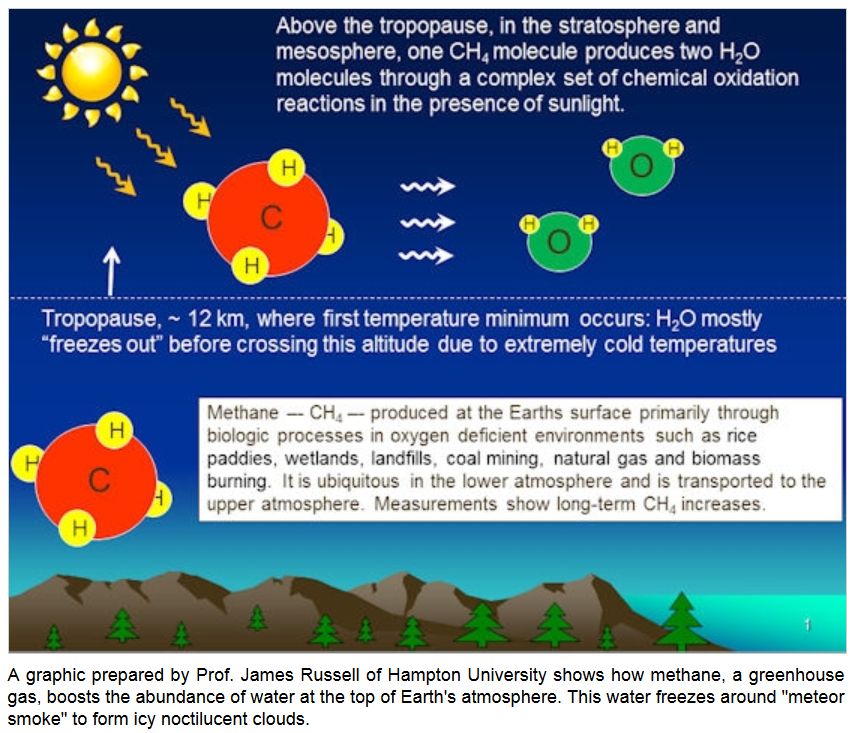
ELECTRIC-BLUE SUMMER CLOUDS: Noctulicent clouds (NLCs) are a phenomenon of summer. Ironically, that is when the top of Earth's atmosphere is cold enough to form ice crystals around meteor smoke--the "stuff" of NLCs. So, you know the summer solstice has arrived when the evening sky starts to look like this:
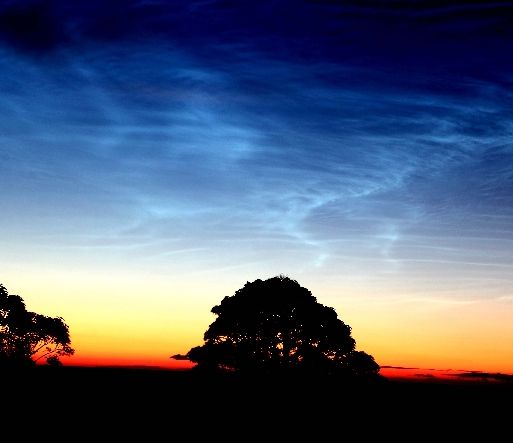
"This fine display of NLCs lasted a number of hours and was visible all across Northern Ireland," says photographer Andy McCrea of Bangor in County Down. "These pictures were taken around 3am on June 20th."
Mark McKenna of Maghera, Northern Ireland, also saw the clouds' signature electric-blue ripples. "This absolutely spectacular noctilucent cloud display was one of the best I have seen in years," he says. "The NLCs were beautiful, glowing vivid white then blue. Of note were the graceful whirls, herringbone, sharp bands and lacunosus holes, the NLCs were even casting shadows onto other NLC forms."
Long ago, NLCs were confined to the Arctic, but in recent years they have been sighted as far south as Colorado and Utah. Some researchers think the increasing visibility is a sign of climate change. Whatever the cause, sky watchers should be alert for NLCs as northern summer unfolds.
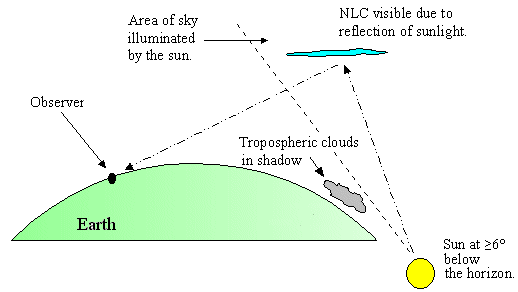
Observing tips: Look west 30 to 60 minutes after sunset when the Sun has dipped 6o to 16o below the horizon. If you see luminous blue-white tendrils spreading across the sky, you may have spotted a noctilucent cloud.