FLYING SAUCER UPDATE: Yesterday, NASA's "flying saucer"--a device designed to deliver heavy payloads to Mars--made its first test flight over Hawaii. "The vehicle worked beautifully, and we met all of our flight objectives," reports project manager Mark Adler of the Jet Propulsion Laboratory. Flight videos and a full report were issued at a news conference on June 29th.
EMERGING SUNSPOTS: A pair of new sunspots is emerging over the sun's eastern limb--and they appear to be bigs ones. NASA's Solar Dynamics Observatory recorded their arrival during the early hours of June 29th:

The sun has been mostly quiet for the past two weeks, and these sunspots could break the quiet. Already they are crackling with C-class solar flares. As the active regions turn toward Earth, we will be able to examine their magnetic fields and evaluate the posssibilitty that they harbor energy for stronger eruptions. Amateur astronomers with backyard solar telescopes are encouraged to monitor developments. Solar flare alerts: text, voice
Realtime Space Weather Photo Gallery
SPRITES AND GRAVITY WAVES: The sprite show continues. "Every day this week, I have been able to photograph red sprites shooting up from the tops of thunderstorms 400 miles away in Colorado, Nebraska and Kansas," reports Jan Curtis of Santa Fe, NM. On June 27th he saw something more: "At around 10:30PM MDT, gravity wave clouds developed and intensified through midnight." This snapshot shows a red sprite cutting through the green ripples:
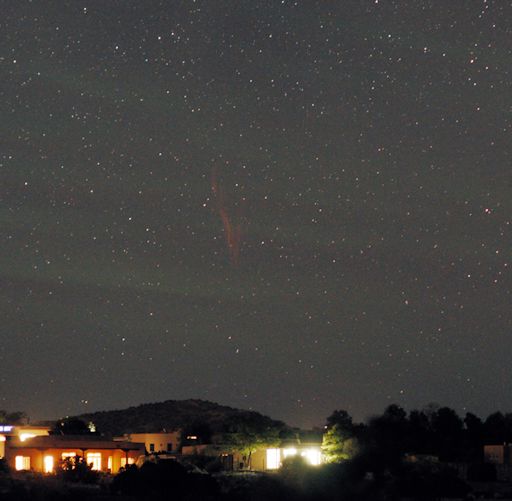
"While I could not detect them with my unaided eyes, time lapse video revealed that the waves were moving very slowly to the northeast," says Curtis.
The waves are, literally, the ripple effect of a powerful thunderstorm on the mesosphere some 80 km above Earth's surface. From space, these waves look like a giant atmospheric bull's eye. The green hue comes from airglow, an aurora look-alike that can be seen on very dark nights from any place on Earth.
Although airglow resembles the aurora borealis, its underlying physics is different. Airglow is caused by an assortment of chemical reactions in the upper atmosphere driven mainly by solar ultraviolet radiation. Auroras, on the other hand, are fueled by gusts of solar wind. While auroras are confined mainly to polar regions, airglow makes a luminous bubble that surrounds the entire planet.
The undulations in the airglow Curtis photographed are caused by temperature and density perturbations rippling away from the central axis of the distant thunderstorm. Speaking simplistically, those perturbations alter chemical reaction rates in the upper atmosphere, leading to more-bright or less-bright bands depending on whether the rates are boosted or diminished, respectively.
Inhabiting the upper reaches of Earth's atmosphere alongside meteors, noctilucent clouds and some auroras, sprites and mesospheric gravity waves are true space weather phenomena. Now is a good time to see them.