LAUNCH POSTPONED, RESET: The launch of NASA's Orbiting Carbon Observatory-2 , originally scheduled for July 1st, was delayed 24 hours because of a technical problem at the launch site. The Delta II rocket is now scheduled to lift off from California's Vandenberg AFB on July 2nd at 02:56:44 PDT. Because the launch occurs on a nearly moonless night, the event could be visible to the naked eye for hundreds of miles - perhaps as far away as portions of Nevada, Arizona, and Mexico. If you see it, and photograph it, submit your images here.
BROODING GIANT: Big sunspot AR2104, which emerged over the weekend, has developed a 'beta-gamma-delta' magnetic field that harbors energy for X-class solar flares. So far, however, the sunspot has been relatively quiet, producing no more than a few minor C-flares. Sergio Castillo photographed the brooding giant on June 30th from his backyard observatory in Inglewood, CA:

Castillo used a solar telescope capped with a "Calcium-K" filter tuned to 3933 Å, a wavelength that reveals the bright magnetic froth around active sunspots. "The magnetic froth is amazingly visible around AR2104," says Castillo. "I truly hope this active region brings fireworks just in time for the 4th of July."
He might get his wish. NOAA forecasters estimate a growing 40% chance of M-class flares and a 5% chance of X-flares during the next 24 hours. The odds of geoeffective eruptions will increase even more in the days ahead as the sunspot turns toward Earth. Solar flare alerts: text, voice
Realtime Space Weather Photo Gallery
SUNSPOTS AND A SPACESHIP: The sunspot number jumped for a fraction of a second on June 30th when a winged silhouette raced across the face of the sun. It was the International Space Station, and Maximilian Teodorescu of Magurele (Ilfov), Romania, captured the transit:
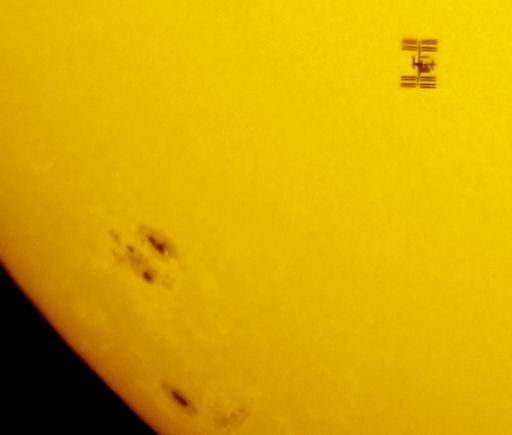
"The moment of transit was predicted by Calsky," says Teodorescu. "Together with my wife, I drove a few kilometers from my workplace and settled into a corn field in 30 degrees Celsius. When the moment came we both pushed our remote control buttons and got the dark silhouette of the ISS close to the freshly emerged sunspot groups AR2104 and AR2107. So for a very brief instant (0.6 seconds) there were three large sunspot groups on the Sun for us."
In New Hampshire, photographer John Stetson saw a similar transit just a few hours later. "International, indeed!" says Stetson.
Realtime Space Weather Photo Gallery