CHANCE OF FLARES: NOAA forecasters estimate a 50% chance of M-class solar flares today. The likely source would be big sunspot AR2104, which has a 'beta-gamma-delta' magnetic field that harbors energy for strong eruptions. Solar flare alerts: text, voice
MORE SUNSPOTS: The sunspot number, already high, ticked upward again today with the arrival of another large active region over the sun's eastern limb. Click to play a 24-hour movie from NASA's Solar Dynamics Observatory--and keep an eye on "AR2109":

The explosive potential of this new sunspot is unknown. It will come into sharper focus later today and tomorrow as the region turns more directly toward Earth, revealing whether or not AR2109 has the kind of unstable magnetic field that leads to strong flares. For now, solar activty remains low despite the increasing sunspot count. Solar flare alerts: text, voice
Realtime Space Weather Photo Gallery
CARBON OBSERVATORY LAUNCHED: Yesterday morning at 2:56 AM PDT, NASA's Orbiting Carbon Observatory-2 (OCO-2) blasted into space from the Vandenberg AFB in California. After liftoff, the exhaust from the satellite's Delta II rocket glowed so brightly that Juan Perez was able to see it 500 miles away in Wittmann, Arizona:

Now orbiting Earth, OCO-2 is set to begin a two-plus year mission to locate the sources and sinks of atmospheric carbon dioxide, the leading human-produced greenhouse gas responsible for global warming. The launch was from the west coast so the spacecraft could enter a polar orbit of the Earth, a flight path that will see it cross over the Arctic and Antarctic regions during each revolution and get a complete picture of the Earth. It will fly about 438 miles above the planet's surface to take its readings. While ground stations have been monitoring carbon dioxide concentrations for years, OCO-2 will be the first spacecraft to conduct a global-scale reading over several seasons. For more views of the launch, browse the realtime photo gallery:
Realtime Space Weather Photo Gallery
ELECTRIC-BLUE SUNRISE: For people in the northern hemisphere, July is the best time of the year to see noctilucent clouds (NLCs). The month got off to a good start on July 1st when the sunrise over Radebeul, Germany turned electric-blue:

"This morning was extremely electric blue over Saxony," says photograher Heiko Ulbricht. "What a great display of noctilucent clouds! I spent much of the night watching the World Cup with friends. At about 2 o'clock in the morning, we drove to a field in Radebeul near the Astronomical Observatory. When the sun came up we were rewarded--a great morning! "
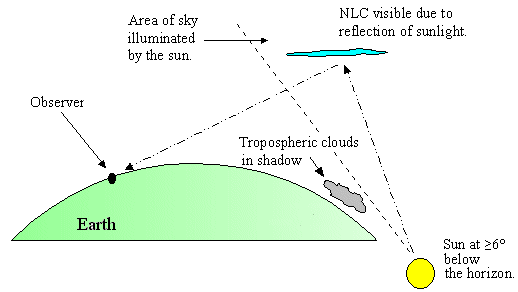
NLCs are Earth's highest clouds. Seeded by "meteor smoke," they form at the edge of space 83 km above Earth's surface. When sunlight hits the tiny ice crystals that make up these clouds, they glow electric blue.
NLCs appear during summer because that is when water molecules are wafted up from the lower atmosphere to mix with the meteor smoke. That is also, ironically, when the upper atmosphere is coldest, allowing the ice crystals of NLCs to form.
The natural habitat of noctilucent clouds is the Arctic Circle. In recent years, however, they have spread to lower latitudes with sightings as far south as Utah and Colorado. This will likely happen in 2014 as well. Observing tips: Look west 30 to 60 minutes after sunset when the Sun has dipped 6o to 16o below the horizon. If you see luminous blue-white tendrils spreading across the sky, you may have spotted a noctilucent cloud.