INCREASING CHANCE OF FLARES: NOAA forecasters have boosted the odds of an M-class solar flare today to 60%. There are two sunspots capable of producing such flares, AR2104 and AR2107, and both are turning toward Earth. Solar flare alerts: text, voice
NOCTILUCENT OUTBURST: Sky watchers in Europe are reporting an outburst of bright noctilucent clouds (NLCs). The display began at sunset on July 3rd, filling northern horizons with electric-blue ripples, swirls, and tendrils of light. Morten Ross sends this picture from Sandbukta, Norway:
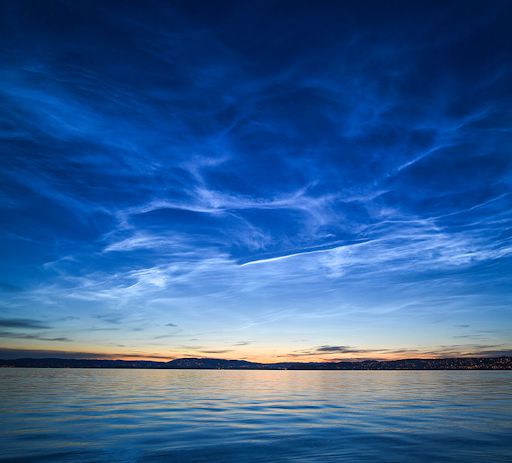
"An incredibly bright and widespread display - from northern horizon to zenith!" says Ross. "This is only the third night of July and its already much better than last year." Similar reports have come from France, Germany, Poland, the Netherlands, Scotland, Ireland, England, Estonia and Belgium.
Although most of the reports so far have come from Europe, the nights ahead could bring NLCs to North America as well. Monitor the realtime gallery for updates:
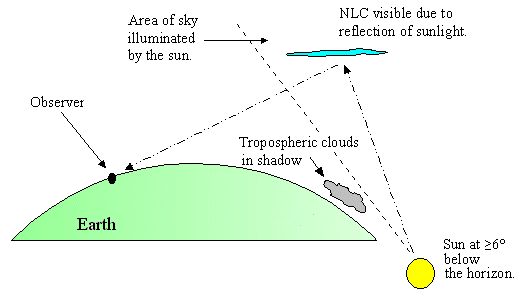
NLCs are Earth's highest clouds. Seeded by "meteor smoke," they form at the edge of space 83 km above Earth's surface. When sunlight hits the tiny ice crystals that make up these clouds, they glow electric blue.
NLCs appear during summer because that is when water molecules are wafted up from the lower atmosphere to mix with the meteor smoke. That is also, ironically, when the upper atmosphere is coldest, allowing the ice crystals of NLCs to form.
The natural habitat of noctilucent clouds is the Arctic Circle. In recent years, however, they have spread to lower latitudes with sightings as far south as Utah and Colorado. This will likely happen in 2014 as well. Observing tips: Look west 30 to 60 minutes after sunset when the Sun has dipped 6o to 16o below the horizon. If you see luminous blue-white tendrils spreading across the sky, you may have spotted a noctilucent cloud.
MONSTER ASTEROIDS CONVERGE: The two most massive objects in the asteroid belt, dwarf planet Ceres and minor planet Vesta, are converging for a close encounter in the night sky on July 4th and 5th. Last night in Italy, Gianluca Masi used a remotely operated telescope to photograph the monster asteroids only 13 arcminutes apart--less than half the width of a full Moon. The line splitting the two is a terrestrial satellite:
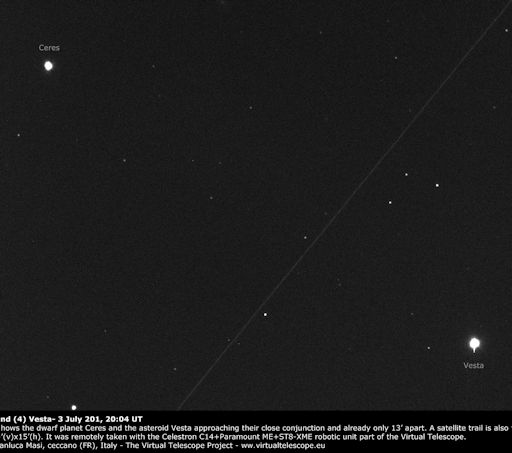
At closest approach on July 5th, the two asteroids will be only 10 arcminutes apart in the constellation Virgo. They are too dim to see with the unaided eye, but easy targets for binoculars and small telescopes. Observing tips are available from Sky and Telescope.
Got clouds? You can watch the close encounter online. Choose between Gianluca Masi's Virtual Telescope Project (which begins July 5th at 4:00 p.m. EDT) or Slooh's webcast (July 3rd at 8 p.m. Eastern Daylight Time).
Quite near the two asteroids on the sky, though utterly invisible, is NASA's Dawn spacecraft. Dawn recently finished visiting Vesta and is now en route to Ceres. The ion-propelled spacecraft will enter orbit around Ceres next March. Cameras on Dawn will resolve the pinprick of light you see this weekend into a full-fledged world of unknown wonders. Stay tuned for that!
Realtime Space Weather Photo Gallery