MOSTLY QUIET WITH A CHANCE OF FLARES: Solar activity is low. However, there are four sunspots facing Earth that pose a threat for geoeffective flares: AR2104, AR2107, AR2108, AR2109. NOAA forecasters estimate a 60% chance that one of those active regions will produce an M-flare during the 4th of July weekend. Solar flare alerts: text, voice
SPACE STATION TRANSITS THE SUN: As wide as a World Cup football field, the biggest spacecraft ever built makes a impressive silhouette when it passes in front of the sun. Yesterday, Maximilian Teodorescu of Romania caught the winged shadow of the International Space Station in conjuncton with sunspots AR2104 and AR2107:
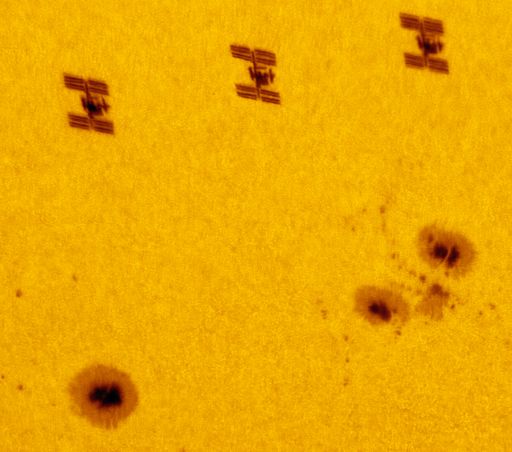
"This is my first attempt to catch the station with a small-sensor camera at high magnification," he says. "I managed to catch the ISS in three frames."
His wife Eliza was right beside him with her own camera and solar filter, and she caught it too. "The moment was all the more spectacular because the ISS path was almost parallel to the very numerous string of sunspots," she notes. One conjunction after another unfolded as their cameras rolled.
With the sunspot number so high, now is a good time to catch ISS-sunspot conjunctions. Check Calsky for local transit predictions.
Realtime Space Weather Photo Gallery
MONSTER ASTEROIDS CONVERGE: The two most massive objects in the asteroid belt, dwarf planet Ceres and minor planet Vesta, are converging for a close encounter in the night sky on July 4th and 5th. Last night in Italy, Gianluca Masi used a remotely operated telescope to photograph the monster asteroids only 13 arcminutes apart--less than half the width of a full Moon. The line splitting the two is a terrestrial satellite:
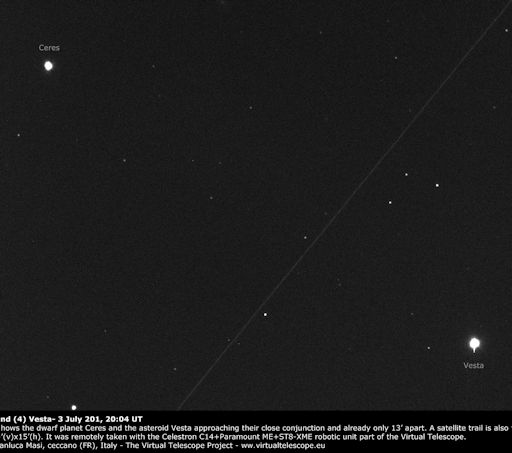
At closest approach on July 5th, the two asteroids will be only 10 arcminutes apart in the constellation Virgo. They are too dim to see with the unaided eye, but easy targets for binoculars and small telescopes. Observing tips are available from Sky and Telescope.
Got clouds? You can watch the close encounter online. Choose between Gianluca Masi's Virtual Telescope Project (which begins July 5th at 4:00 p.m. EDT) or Slooh's webcast (July 3rd at 8 p.m. Eastern Daylight Time).
Quite near the two asteroids on the sky, though utterly invisible, is NASA's Dawn spacecraft. Dawn recently finished visiting Vesta and is now en route to Ceres. The ion-propelled spacecraft will enter orbit around Ceres next March. Cameras on Dawn will resolve the pinprick of light you see this weekend into a full-fledged world of unknown wonders. Stay tuned for that!