WAITING FOR FLARES: For days, solar activity has been low, but the quiet seems unlikely to last. Two big sunspots, AR2108 and AR2109, have unstable "beta-gamma-delta" magnetic fields that harbor energy for strong, Earth-directed eruptions. NOAA forecasters estimate a 60% chance of M-flares and a 10% chance of X-flares on July 7th. Solar flare alerts: text, voice
BRIGHT NOTILUCENT CLOUDS: Last night, another bright display of noctilucent clouds lit up the skies over Europe. The luminous ripples were so bright, "they actually lit up my room a blue colour," reports UK photographer Mark Savage. Click on this photo to set the clouds in motion over his hometown, Gateshead, England:

"This was the best display of noctilucent clouds I've seen for a number of years," he says. Similar reports have been received from Poland, Scotland, Russia and other parts of Europe.
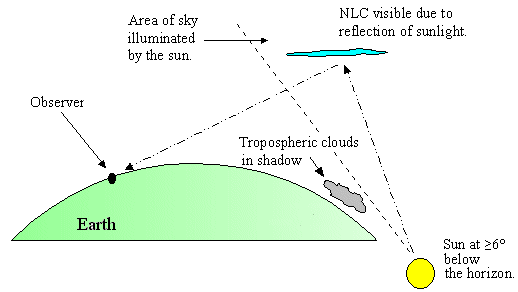
July is the best month of the year for noctilucent clouds in the northern hemisphere. So far, the vast majority of sightings have been in Europe. It is only a matter of time however, before the electric-blue ripples spread to North America. Observing tips: Look west 30 to 60 minutes after sunset when the Sun has dipped 6o to 16o below the horizon. If you see luminous blue-white tendrils spreading across the sky, you may have spotted a noctilucent cloud.
SPACE STATION TRANSITS THE SUN: As wide as a World Cup football field, the biggest spacecraft ever built makes a impressive silhouette when it passes in front of the sun. On July 5th, Maximilian Teodorescu of Romania caught the winged shadow of the International Space Station in conjuncton with sunspots AR2104 and AR2107:
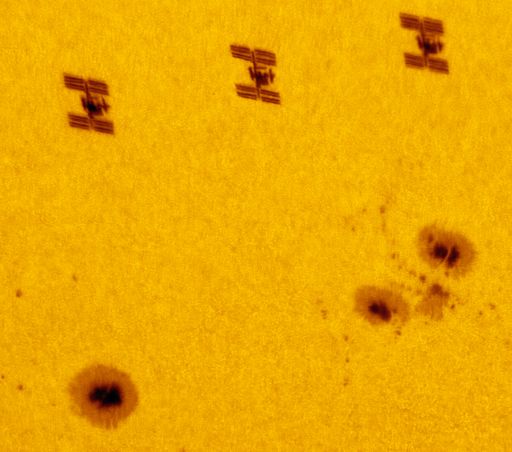
"This is my first attempt to catch the station with a small-sensor camera at high magnification," he says. "I managed to catch the ISS in three frames."
His wife Eliza was right beside him with her own camera and solar filter, and she caught it too. "The moment was all the more spectacular because the ISS path was almost parallel to the very numerous string of sunspots," she notes. One conjunction after another unfolded as their cameras rolled.
With the sunspot number so high, now is a good time to catch ISS-sunspot conjunctions. Check Calsky for local transit predictions.
Realtime Space Weather Photo Gallery