A "NEW STAGE OF OPERATIONS" FOR STEREO: Space weather forecasters are going to miss the STEREO probes. Since they launched in 2006, the twin spacecraft have become indispensable for monitoring global solar activity and making 3D models of solar storm clouds bearing down on Earth. The problem is, high-gain antennas on the spacecraft are oversensitive to solar heat. As the two probes pass behind the sun later this year, they won't be able to beam data to Earth without overheating their own antennas. This will lead to a sharp reduction of science data lasting more than a year. NASA is calling the near-blackout a "new stage of operations." If all goes well, STEREO will be back to normal in January 2016.
M-CLASS SOLAR FLARE: Forecasters expected a solar flare today, and indeed one has occurred. But it came from an unexpected source. Emerging sunspot AR2113 showed that it is capable of strong flares with an M6-class eruption at 1630 UT on July 8th. NASA's Solar Dynamics Observatory recorded the extreme ultraviolet flash:
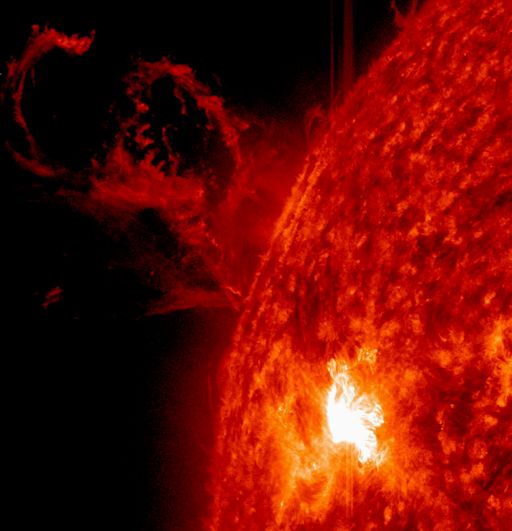
Ionizing radiation from the flare briefly disturbed the propagation of shortwave radio transmissions on the dayside of Earth, but conditions have since returned to normal. The impulsive flare might have produced a coronal mass ejection (CME); if so, the storm cloud is almost certainly not heading toward Earth. For now, this sunspot is too far off the sun-Earth line to produce geoeffective CMEs.
With this flare, AR2113 joins two other sunspots capable of potent activity: AR2108 and AR2109. NOAA forecasters estimate a 70% chance of M-flares and a 15% chance of X-flares on July 8th. Solar flare alerts: text, voice
Realtime Space Weather Photo Gallery
ELECTRIC-BLUE SUNRISE: This morning in Russia, the sunrise was electric-blue. Bright bands of noctilucent clouds zig-zagged like lightning across the twilight sky, continuing a two-day display that has delighted observers across northern Europe. Michael Zavyalov sends this picture taken July 8th from the city of Yaroslavl:
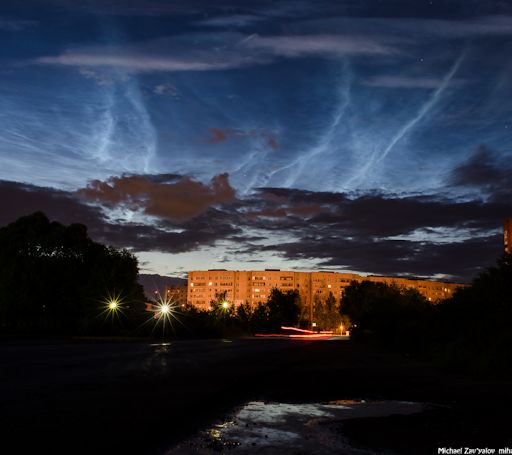
"Another night with bright noctilucent clouds (NLCs) in Yaroslavl!" says Zavyalov. "We could even see their reflection in the water."
NLCs are Earth's highest clouds. Seeded by "meteor smoke," they form at the edge of space 83 km above Earth's surface. When sunlight hits the tiny ice crystals that make up these clouds, they glow electric blue.
In the northern hemisphere, July is the best month to see them. NLCs appear during summer because that is when water molecules are wafted up from the lower atmosphere to mix with the meteor smoke. That is also, ironically, when the upper atmosphere is coldest, allowing the ice crystals of NLCs to form.
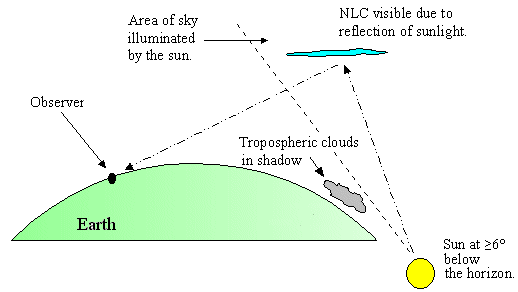
The natural habitat of noctilucent clouds is the Arctic Circle. In recent years, however, they have spread to lower latitudes with sightings as far south as Utah and Colorado. This will likely happen in 2014 as well. Observing tips: Look west 30 to 60 minutes after sunset when the Sun has dipped 6o to 16o below the horizon. If you see blue-white tendrils zig-zagging across the sky, you may have spotted a noctilucent cloud.