HELIOPHYSICS SUMMER SCHOOL: The 2014 Heliophysics Summer School is underway in Boulder, CO, and Dr. Tony Phillips (@spaceweatherman) is tweeting from the classroom. Follow the lectures on Twitter using the hashtag #helioschool.
RADIO STATIC FROM THE SUN: The M6-flare of July 8th, described below, had a noisy side-effect. It caused a roar of static to issue from the loudspeakers of shortwave radios on Earth. In New Mexico, amateur radio astronomer Thomas Ashcraft recorded the sounds:
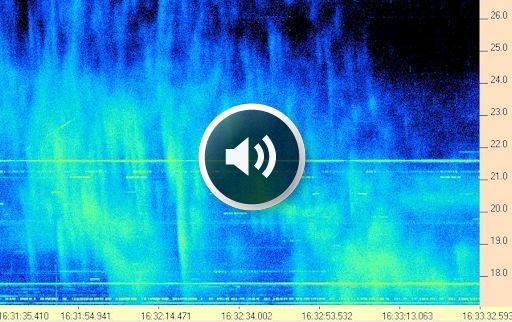
"The M6.5 flare yesterday generated a complex mix of Type II and Type IV solar radio emissions," says Ashcraft. "This two minute audio sample, recorded in stereo at the frequencies of 23 MHz and 21 MHz, captures the dynamic character of the bursts."
Radio bursts such as these are sparked by shock waves moving through the sun's atmosphere. Set in motion by flares, these shock waves excite plasma instabilitties that emit static-y radio waves. Becase there are a whole variety of plasma instabilites, there is a corresponding variety of radio burst types. Ashcraft recorded two: Type II and Type IV. More examples may be found here.
SOLAR FLARE ERUPTS FROM UNEXPECTED SOURCE: Yesterday, July 8th, Earth-orbiting satellites detected a strong M6-class solar flare. NASA's Solar Dynamics Observatory recorded the extreme ultraviolet flash:
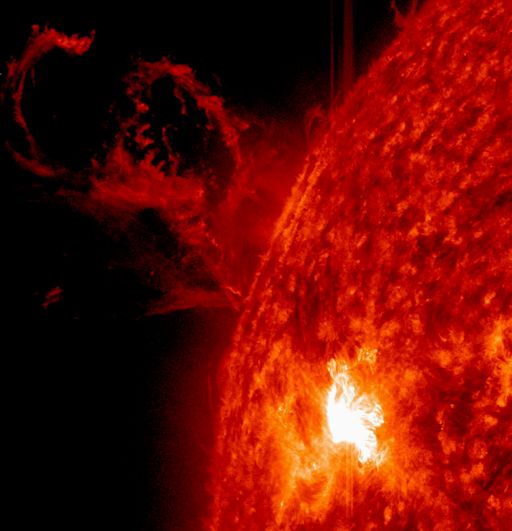
X-ray and UV radiation from the flare sent waves of ionization coursing through Earth's upper atmosphere. This briefly disturbed the propagation of shortwave radio transmissions around the dayside of our planet, especially over Europe and North America. Conditions have since returned to normal.
The flare came as little surprise. A phalanx of large sunspots is crossing the solar disk, and forecasters have been predicting an explosion for more than a week. However, the source of the flare was unexpected. It came from a minor and seemingly harmless sunspot named AR2113. Appearances notwithstanding, AR2113 has a 'beta-gamma' magnetic field that harbors energy for M-class solar flares.
With this flare, AR2113 joins two other sunspots capable of potent activity: AR2108 and AR2109. NOAA forecasters estimate a 75% chance of M-flares and a 20% chance of X-flares on July 9th. Solar flare alerts: text, voice
Realtime Space Weather Photo Gallery
SPOTTY SUNRISE: Astrophotographers around the world are snapping pictures of this week's large sunspots. "After taking some sunspot images yesterday afternoon, I was thinking that it would be nice to capture the spotty Sun at sunrise," says Stephen Mudge of Brisbane, Australia. "And then I thought it would be even nicer if that sunrise was behind the city buildings. So after a bit of time studying Stellarium and looking at maps, and then a quick reconnaissance drive, I settled on Green Hill Reservoir as a suitable location for a photo shoot." This was the result
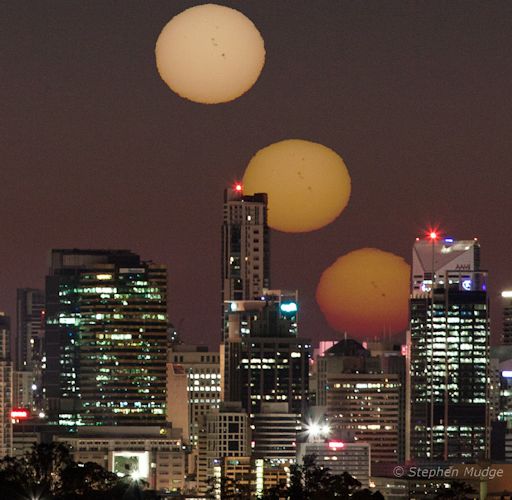
"I got up there just as dawn started and took some panoramas of the city. Then, with the camera still in position on the tripod, I added a Baader solar filter and captured the rising sun with exposures every 3.5 minutes," explains Mudge. "I managed to pick the location perfectly (with the Sun rising right in the middle of the city), and the weather cooperated beautifully, so I'm pretty happy with the result!"
Who knew sunspots could be a muse for creative photography? Check the realtime photo gallery for more examples.
ELECTRIC-BLUE SUNRISE: Yesterday morning in Russia, the sunrise was electric-blue. Bright bands of noctilucent clouds zig-zagged like lightning across the twilight sky, continuing a two-day display that has delighted observers across northern Europe. Michael Zavyalov sends this picture taken July 8th from the city of Yaroslavl:
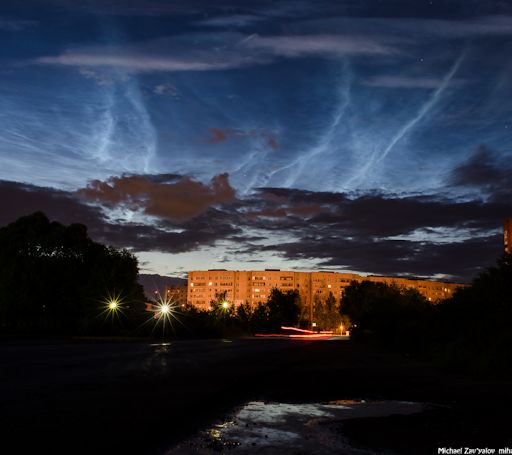
"Another night with bright noctilucent clouds (NLCs) in Yaroslavl!" says Zavyalov. "We could even see their reflection in the water."
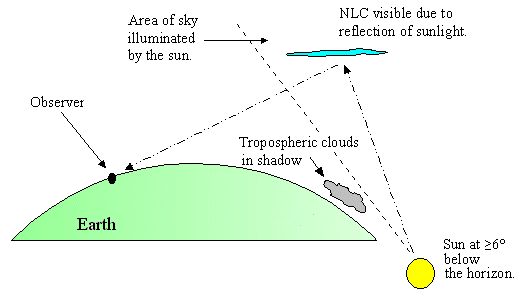
NLCs are Earth's highest clouds. Seeded by "meteor smoke," they form at the edge of space 83 km above Earth's surface. When sunlight hits the tiny ice crystals that make up these clouds, they glow electric blue.
In the northern hemisphere, July is the best month to see them. NLCs appear during summer because that is when water molecules are wafted up from the lower atmosphere to mix with the meteor smoke. That is also, ironically, when the upper atmosphere is coldest, allowing the ice crystals of NLCs to form.
The natural habitat of noctilucent clouds is the Arctic Circle. In recent years, however, they have spread to lower latitudes with sightings as far south as Utah and Colorado. This will likely happen in 2014 as well. Observing tips: Look west 30 to 60 minutes after sunset when the Sun has dipped 6o to 16o below the horizon. If you see blue-white tendrils zig-zagging across the sky, you may have spotted a noctilucent cloud.