INCOMING CME, GLANCING BLOW POSSIBLE: Earth could receive a glancing blow from a CME on July 13th. It comes from a magnetic filament that erupted from the sun's northern hemisphere on July 9th and hurled part of itself into space. Minor geomagnetic storms are possible when the CME arrives. Follow the action @spaceweatherman.
THREE SUPERMOONS IN A ROW: Get ready for moonlight. The next three full moons are perigee "supermoons," as much as 14% closer and 30% brighter than other full moons of the year. The show begins with the full Moon of July 12th. Get the full story and a video from Science@NASA.
SUNSPOTS AT MIDNIGHT: This week, the sun is peppered with big spots. In some places, you can see them even at midnight. "Here in Lofoten islands, north of the Arctic circle, the sun never sets," reports Therese van Nieuwenhoven, "so we can observe sunspots around the clock.:

"As we enjoyed the beautiful midnight Sun in the north above the sea, my husband was projecting the large sunspots on a white piece of paper," she explains.

Earlier in the week, several of these sunspots posed a threat for strong flares, but now the odds of an explosion are declining. Only one of the decaying active regions (AR2108) still has an unstable 'beta-gamma' magnetic field. NOAA forecasters estimate a waning 60% chance of M-flares on July 11th. Solar flare alerts: text, voice
Realtime Space Weather Photo Gallery
SERPENTINE NOCTILUCENT CLOUDS: After weeks of sightings over Europe, noctilucent clouds (NLCs) are spreading to North America. "A spectacular display emerged over the Edmonton area on July 8/9," reports Canadian photographer Mark Zalcik. "For awhile there were multiple zones of billow-type NLC, including the snake-like one in this photo."

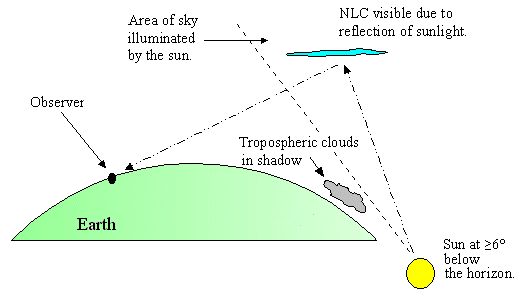
NLCs are Earth's highest clouds. Seeded by "meteor smoke," they form at the edge of space 83 km above Earth's surface. When sunlight hits the tiny ice crystals that make up these clouds, they glow electric blue.
In the northern hemisphere, July is the best month to see them. NLCs appear during summer because that is when water molecules are wafted up from the lower atmosphere to mix with the meteor smoke. That is also, ironically, when the upper atmosphere is coldest, allowing the ice crystals of NLCs to form.
The natural habitat of noctilucent clouds is the Arctic Circle. In recent years, however, they have spread to lower latitudes with sightings as far south as Utah and Colorado. This will likely happen in 2014 as well. Observing tips: Look west 30 to 60 minutes after sunset when the Sun has dipped 6o to 16o below the horizon. If you see blue-white tendrils zig-zagging across the sky, you may have spotted a noctilucent cloud.