GROWING QUIET: The odds of an Earth-directed solar flare are plummeting as sunspots AR2108 and AR2109 rotate over over the sun's western limb. The departure of these two active regions leaves the face of the sun almost blank. Solar activity should remain low for the next 24-48 hours.
FLY ME TO THE SUPERMOON: The Moon's orbit around Earth is not a circle, it's an ellipse. When a full Moon occurs on the near side of the orbit, it looks extra big and bright, and we call it a "supermoon." The first of three supermoons arrived on July 12th:

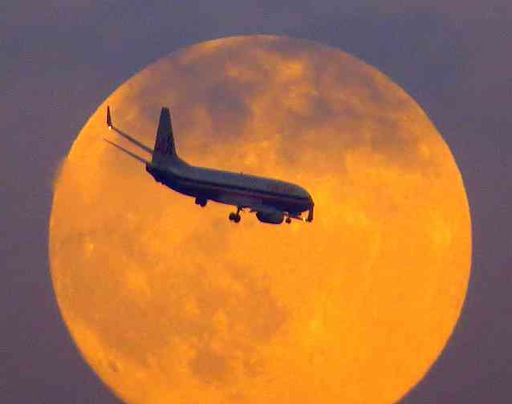
"This weekend I was on my deck taking some zoom photos of the supermoon when an airplane flew by," says photographer Ralfo Winter. "It was coming in for a landing at New York City."
As explained in a video from Science@NASA, the technical term for this phenomenon is "perigee Moon." A nearby perigee Moon can be 14% bigger and 30% brighter than other full Moons of the year. This kind of Moon is not particularly rare; they come along every 13 months or so. However, this summer we will have three supermoons in a row. The next one is August 12th.
Realtime Space Weather Photo Gallery
NOCTILUCENT CLOUDS: The weekend of July 12-13 brought another outbreak of noctilucent clouds (NLCs) to Europe. Across the northern reaches of the continent, skies were criss-crossed by signature ripples of electric blue, like these photographed by Jaan Jalgratas of Tartu, Estonia:
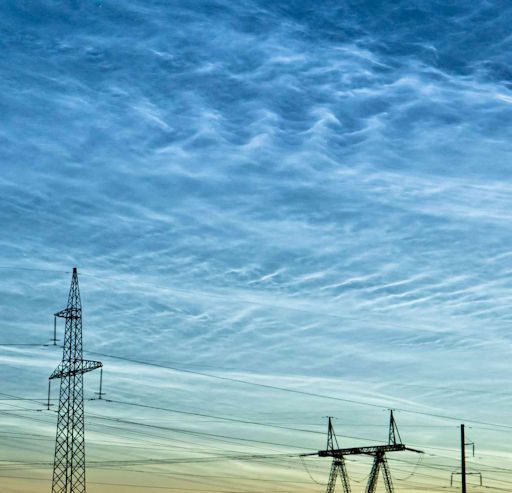
"The display was very bright and it extended at least 35 degrees above the horizon," says Jalgratas. "It was my best sighting ever."
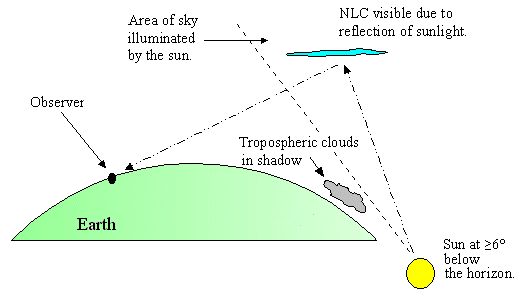
NLCs are Earth's highest clouds. Seeded by "meteor smoke," they form at the edge of space 83 km above Earth's surface. When sunlight hits the tiny ice crystals that make up these clouds, they glow electric blue.
In the northern hemisphere, July is the best month to see them. NLCs appear during summer because that is when water molecules are wafted up from the lower atmosphere to mix with the meteor smoke. That is also, ironically, when the upper atmosphere is coldest, allowing the ice crystals of NLCs to form.
The natural habitat of noctilucent clouds is the Arctic Circle. In recent years, however, they have spread to lower latitudes with sightings as far south as Utah and Colorado. This will likely happen in 2014 as well. Observing tips: Look west 30 to 60 minutes after sunset when the Sun has dipped 6o to 16o below the horizon. If you see blue-white tendrils zig-zagging across the sky, you may have spotted a noctilucent cloud.