SUNSPOT NUMBER DROPS TO ZERO: Solar activity is very low. July 17th brought the first spotless day in nearly three years. The face of the sun was completely blank and the sunspot number dropped to zero. Now, however, two small sunspots are emerging, circled in this image from NASA's Solar Dynamics Observatory:
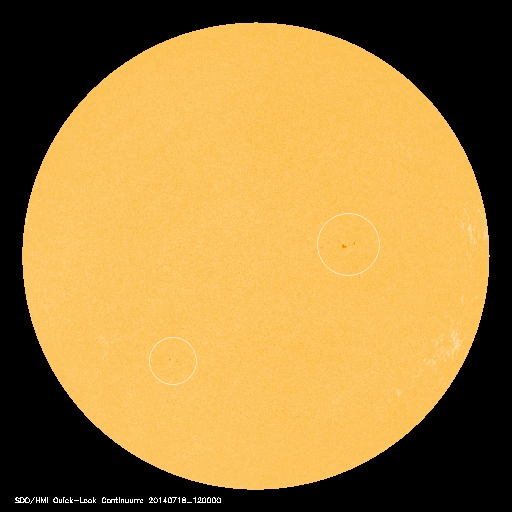
Neither of these small spots has the kind of complex magnetic field that harbors energy for strong flares. The quiet is therefore expected to continue through the weekend. NOAA forecasters estimate the odds of an M-flare in the next 3 days to be no more than 1%.
Before July 17, 2014, the previous spotless day was August 14, 2011, a gap of nearly 3 years. What happened then provides context for what is happening today. Overall, 2011 was a year of relatively high solar activity with multiple X-flares; the spotless sun was just a temporary intermission. 2014 will probably be remembered the same way. As new sunspots emerge and grow, the Solar Max of 2014 will pick up where it left off a couple weeks ago when sunspots were abundant. However, because no one can predict the solar cycle, this "All Quiet Event" is worth monitoring.
Follow the action, or lack thereof, on Twitter @spaceweatherman.
Realtime Space Weather Photo Gallery
NOCTILUCENT vs. TROPOSPHERIC CLOUDS: Floating more than 80 km above Earth's surface, electric-blue NLCs are our planet's highest clouds. As a result, it is easy for lower clouds to get in the way of their easy visbility. Last night in Sweden, P-M Hedén recorded the contest between the two. Play the video to see how, in the end, the NLCs won out:

"Dark clouds passed overhead at midnight, but behind those clouds I could see bright electric ones - the beautiful Noctilucent clouds!" says Hedén.
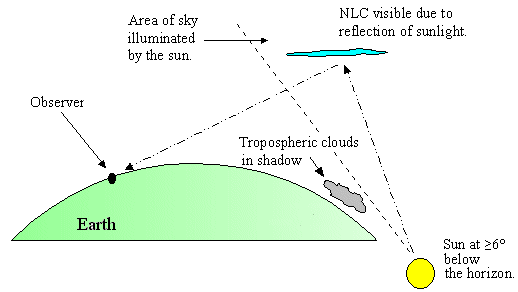
His video highlights the altitude difference between ordinary clouds in the troposphere and noctilucent clouds in the mesosphere. At 80+ km, NLCs are high enough to catch the rays of the sun even around midnight. At 5 to 10 km, tropospheric clouds are midnight dark.
The natural habitat of noctilucent clouds is the Arctic Circle. In recent years, however, they have spread to lower latitudes with sightings as far south as Utah and Colorado. Many researchers think this is a result of climate change. Observing tips: Look west 30 to 60 minutes after sunset when the Sun has dipped 6o to 16o below the horizon. If you see blue-white tendrils zig-zagging across the sky, you may have spotted a noctilucent cloud.
ROSETTA COMET IS A CONTACT BINARY: The European Space Agency's Rosetta probe is approaching Comet 67P/Churyumov-Gerasimenko for a historic mission to orbit and land on the comet's nucleus. As Rosetta approaches the comet (now less than 10,000 km away), the form of the nucleus is coming into focus. And it is strange:

Some observers have noted the comet's resemblance to a rubber duck. The technical term is "contact binary." One elongated object appears stuck to a smaller bulbous piece. No one knows how the comet came to be this way. It could be the result of a slow-motion "sticky collision" between two objects, an odd-shaped fragment of a catastrophic impact, or something else entirely. One thing is sure: This could present some interesting challenges for Philae, the probe's lander, which is slated to touch down on the comet's surface in early November.
Many questions will be answered by August 6th when Rosetta reaches 67P and goes into orbit. Stay tuned!