THE ALL QUIET EVENT: The "All Quiet Event" is still underway. For the 6th day in a row, solar activity is extremely low, with weak solar wind, no flares, and a sunspot number near zero. NOAA forecasters put the odds of a significant flare today at no more than 1%. Follow the action, or lack thereof, on Twitter @spaceweatherman.
RED SPRITES OVER NEW MEXICO: Solar activity is extremely low. Nevertheless, space weather continues. High above thunderstorms in the American west, red sprites are dancing across the cloudtops, reaching up to the edge of space itself. Harald Edens photographed this specimen on July 18th from the Langmuir Laboratory for Atmospheric Research in New Mexico:
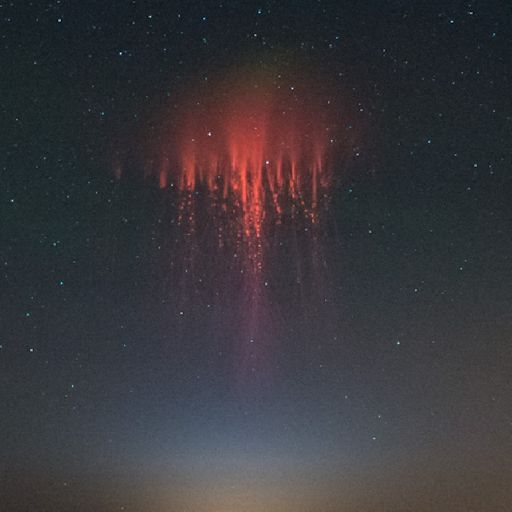
"This colorful sprite occurred over a large thunderstorm system in northeast New Mexico and was visible to the naked eye," says Edens. "I took the picture using a Nikon D4s and a 50 mm f/2 lens at ISO 25600."
Inhabiting the upper reaches of Earth's atmosphere alongside noctilucent clouds, meteors, and some auroras, sprites are a true space weather phenomenon. Some researchers believe they are linked to cosmic rays: subatomic particles from deep space striking the top of Earth's atmosphere produce secondary electrons that, in turn, could provide the spark that triggers sprites.
Although sprites have been seen for at least a century, most scientists did not believe they existed until after 1989 when sprites were photographed by cameras onboard the space shuttle. Now "sprite chasers" regularly photograph the upward bolts from their own homes. Give it a try!
FARSIDE CME: During the early hours of July 20th, a coronal mass ejection (CME) exploded from the far side of the sun. SOHO recorded the cloud as it billowed over the sun's northeastern limb:

Although the CME appears to envelop Jupiter, it does not. Jupiter is almost 500 million miles behind the sun. The apparent intersection is just the CME passing in front of the giant planet.
Images taken by NASA's STEREO-B probe, which is stationed over the farside of the sun, suggest that the CME was propelled into space by an erupting filament of magnetism possibly connected to a small sunspot. We will get a direct view of the blast site in a few days when it rotates onto the Earthside of the sun. Overall, solar activity remains low despite this relatively minor outburst.
Realtime Space Weather Photo Gallery