QUIET SUN: Solar activity remains very low. There is only one sunspot (AR2119) on the Earth-facing side of the sun, and it has a simple magnetic field that poses no threat for strong explosions. NOAA forecasters estimate a scant 1% chance of M- or X-flares during the next 24 hours. Follow the action, or lack thereof, on Twitter @spaceweatherman.
MIDNIGHT SUNDOGS: Some of us have seen the midnight sun. Even more have witnessed sundogs. But have many people have seen a mashup of the two--the elusive midnight sundog? On July 21-22, Stine Bratteberg photographed the combo from Bleik, Andøya, Norway:
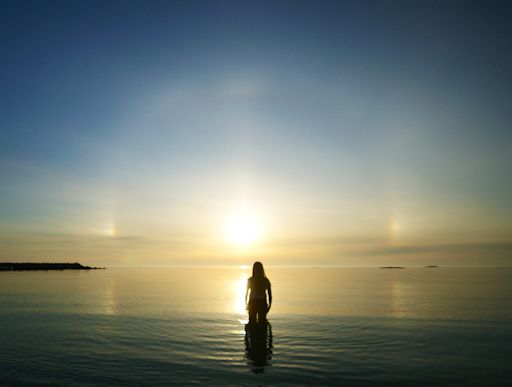
"These fantastic sundogs appeared near midnight on the last day of the summer Midnight Sun here in northern Norway," says Bratteberg.
Sundogs, the rainbow-colored splashes of light on either side of the sun, are caused by sunlight striking ice crystals in the air. Plate-shaped crystals flutter down from the sky like leaves falling from trees. Aerodynamic forces align their flat sides parallel to the ground, and when sunlight hits a patch of well-aligned crystals at the right distance from the sun, voila!--a sundog. Bratteberg's photo also captured a faint midnight sun halo and a midnight upper tangent arc.
You can see a lot of midnight atmospheric optics from the Arctic Circle. But not for much longer. As northern summer comes to an end, the midnight sun will fade and auroras will chase the sundogs into the darkening Arctic night. Monitor the realtime aurora gallery for updates.
Realtime Space Weather Photo Gallery
NOCTILUCENT CLOUDS: Last night, a bank of noctilucent clouds (NLCs) rippled across northern Europe. "They were stunning," reports Alex Lebedev, who witnessed the apparition from Kohtla-Järve, Ida-Virumaa, Estonia. The display was so wide, it doesn't fit in the space provided below; click to view the complete panorama:

"Viewing it by eye was even better than the photo," he says.
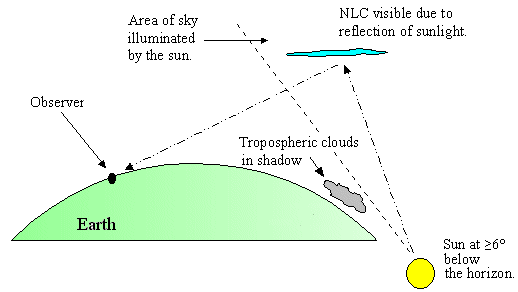
NLCs are Earth's highest clouds. Seeded by "meteor smoke," they form at the edge of space 83 km above Earth's surface. When sunlight hits the tiny ice crystals that form around the meteor debris, the clouds glow electric blue.
July is the best month to see NLCs. They favor the climate of summer because that is when water molecules, warmed by summer sunlight, are wafted up from the lower atmosphere to mix with the meteor smoke. That is also, ironically, when the upper atmosphere is coldest, allowing the ice crystals of NLCs to form.
The natural habitat of noctilucent clouds is the Arctic Circle. In recent years, however, they have spread to lower latitudes with sightings as far south as Utah and Colorado. This will likely happen in 2014 as well. Observing tips: Look west 30 to 60 minutes after sunset when the Sun has dipped 6o to 16o below the horizon. If you see blue-white tendrils zig-zagging across the sky, you may have spotted a noctilucent cloud.