THE SOLAR SUPERSTORM OF JULY 2012: This week marks the second anniversary of a scary near-miss. On July 23, 2012, Earth narrowly evaded a powerful solar storm capable of knocking civilization back into the 19th century. The event confirms that "solar superstorms" are real, and the odds of impact may be higher than previously supposed: full story.
NOCTILUCENT CLOUDS: Noctilucent clouds (NLCs), which ring the Arctic Circle during the months of northern summer, often begin to fade in late July/early August. This year, they are still going strong. "Last night we witnessed another vivid display of NLCs," reports Timo Newton-Syms, who sends this picture from Helsinki, Finland:

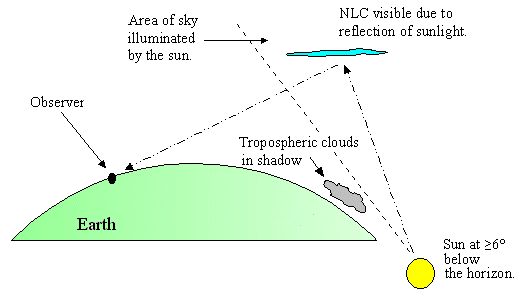
Seeded by meteor smoke, NLCs are Earth's highest clouds. They glow electric-blue when sunlight strikes them more than 80 km above Earth's surface. Meanwhile, closer to the ground, ordinary tropospheric clouds are relatively dark as they are shadowed by the body of the planet below.
"The contrast between the two types of clouds is evident in my photo," says Newton-Syms.
The natural habitat of noctilucent clouds is the Arctic Circle. In recent years, however, they have spread to lower latitudes with sightings as far south as Utah and Colorado. This may yet happen in 2014 even as the season comes to an end. Observing tips: Look west 30 to 60 minutes after sunset when the Sun has dipped 6o to 16o below the horizon. If you see blue-white tendrils zig-zagging across the sky, you may have spotted a noctilucent cloud.
RADIO BURSTS FROM JUPITER: This week, Jupiter is passing behind the sun. Normally solar interference would make it difficult for radio astronomers to pick up Jupiter's shortwave radio bursts. Because the sun is so quiet, however, Jupiter is still able to maake itself heard. "I was able to capture distinct narrow-band radio emissions from Jupiter on July 21st," reports Thomas Ashcraft of New Mexico. They are the sloping lines in this dynamic spectrum he recorded using a RadioJove Project dual dipole antenna:

"At the time Jupiter was 6.3 Astronomical Units (585,621,586 miles) distant from Earth," he adds. "I think this is a neat observation because it means there is always the possibility of receiving Jupiter radio emissions here on Earth--even when the sun is in the way and Jupiter is very distant."
Jupiter's radio storms are caused by natural radio lasers in the planet's magnetosphere that sweep past Earth as Jupiter rotates. Electrical currents flowing between Jupiter's upper atmosphere and the volcanic moon Io can boost these emissions to power levels easily detected by ham radio antennas on Earth. Jovian "S-bursts" and "L-bursts" mimic the sounds of woodpeckers, whales, and waves crashing on the beach. Here are a few audio samples: S-bursts, S-bursts (slowed down 128:1), L-Bursts. The type of emissions Ashcraft picked up on July 21st were S-bursts.
Realtime Space Weather Photo Gallery