COUNTDOWN TO THE ROSETTA COMET: The European Space Agency's Rosetta spacecraft is now less than 2300 km from Comet 67P/Churyumov-Gerasimenko. In only 9 days, Rosetta will reach the comet's core and go into orbit around it. Latest images from the probe's navigation camera show a strangely-shaped nucleus that is coming into sharper focus day by day. Follow the action @ESA_Rosetta.
RED AURORAS: A minor solar wind stream is buffeting Earth's magnetic field today, and this is sparking auroras at high latitudes. Ray Stinson photographed the display during the morning hours of July 28th over Glacier National Park in St Mary, Montana:
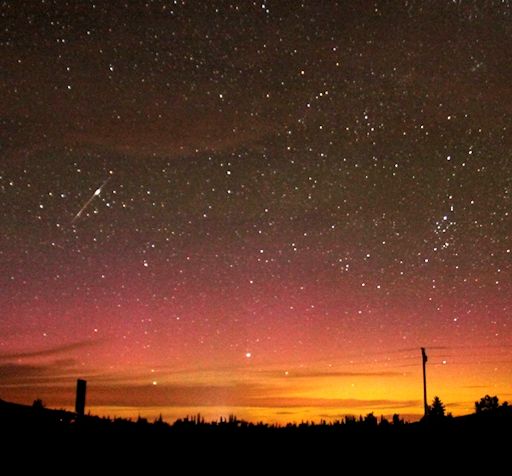
"The auroras were weak, but I was able to record them using a 20 sec exposure at ISO 4000," says Stinson. "Also, a meteor streaked by during the exposure."
More auroras are possible tonight, albeit weak ones. Long exposures such as Stinson used will help bring out their color and underling structure. NOAA forecasters estimate a 20% chance of polar geomagnetic storms on July 28-29 as the solar wind continues to blow. Aurora alerts: text, voice
PERSEID METEOR SHOWER BEGINS: Earth is entering a broad stream of debris from Comet Swift-Tuttle, source of the annual Perseid meteor shower. Although the peak of the shower is not expected until August, meteors are already flitting acrosss the night sky. On July 27th, NASA cameras caught this Perseid fireball flying over New Mexico:
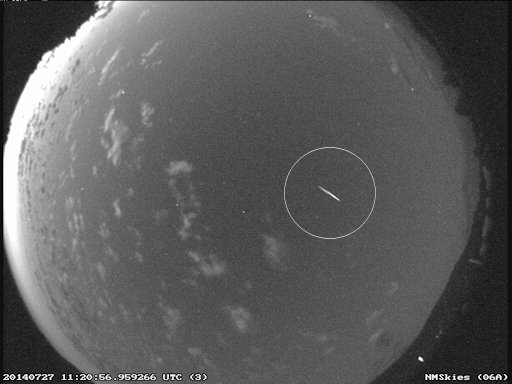
Over the weekend, NASA detected a total of six Perseid fireballs, a "micro-flurry" that signals the beginning of the annual display. Normally the best time to watch would be during the shower's peak: August 11th through 13th. This year, however, the supermoon will cast an interfering glare across the nights of maximum activity, reducing visibility from 120 meteors per hour (the typical Perseid peak rate) to less than 30. Instead, late July-early August might be the best time to watch as Earth plunges deeper into the debris stream before the Moon becomes full.
If you go out meteor watching in the nights ahead, you'll likely see another shower, too: the Southern Delta Aquariids. Produced by debris from Comet 96P/Machholz, this shower peaks on July 29-30 with 15 to 20 meteors per hour. This is considered to be a minor shower, but rich enough in fireballs to merit attention. NASA will stream the display from an observing site at the Marshall Space Flight Center in Alabama. Live video begins on July 29th at 9:30 pm EDT.
Got clouds? Try listening to the Perseids and the Southern Delta Aquariids on Space Weather Radio. The audio stream is playing echoes from a forward-scatter meteor radar in Roswell, New Mexico.
Realtime Space Weather Photo Gallery