PERSEID METEORS: The Perseid meteor rate is increasing as Earth moves deeper into the debris stream of Comet Swift-Tuttle. Last night, NASA's network of all-sky cameras recorded 6 Perseid fireballs, equal to the sum of the previous five nights combined. Although the shower does not peak until the 2nd week of August, now is a good time to look for these meteors because the night sky is relatively free of lunar glare. Peak night, on the other hand, will be lit up by a supermoon. Get the full story from Science@NASA.
THE MARS COMET APPROACHES: On Oct. 19, 2014, Comet Siding Spring (C/2013 A1) will pass extremely close to Mars. For a while last year researchers thought the comet's core might strike the planet's surface. Now we know that it will be a near miss. Siding Spring will glide by Mars 132,000 km away--ten times closer than any comet has come to Earth in recorded history. On July 27th, Rolando Ligustri photographed the comet gliding through a field of galaxies en route to Mars:
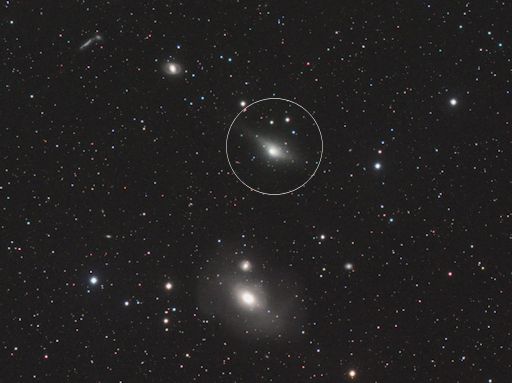
"I took the picture using a telescope at the Siding Spring Observatory in Australia (where the comet was discovered)," says Ligustri. " The big galaxy to the south of the comet is NGC1316."
Although the comet's nucleus will not strike Mars, there is a good chance that gas and dust spewing out of the comet's core will interact with the Martian atmosphere. There could be a meteor shower, auroras, and other effects that no one can predict. NASA's fleet of Mars spacecraft and rovers will record whatever happens.
Amateur astronomers can monitor the comet's approach to Mars in the months ahead. Right now, Siding Spring is gliding through the southern constellation Fornax glowing about as brightly as a 12th magntitude star. Mid-sized telescopes such as the Comet Hunter equipped with CCD cameras should have no trouble picking it up. [light curve] [ephemeris] [3D orbit]
ONE WEEK TO THE ROSETTA COMET: The European Space Agency's Rosetta spacecraft is now less than 1700 km from Comet 67P/Churyumov-Gerasimenko. In only 7 days, Rosetta will reach the comet's core and go into orbit around it. Latest images from the probe's navigation camera show a strangely-shaped nucleus that is coming into sharper focus day by day. Follow the action @ESA_Rosetta.
Magnetic filament update: The sinuous filament pictured below has erupted, and might might have hurled a coronal mass ejection in the general direction of Earth. Stay tuned.
DARK FILAMENT ON THE SUN: As the sunspot number rebounds from a deep low in mid-July, the chance of flares is increasing, too. However, the biggest threat for a flare today might not be a sunspot at all. Instead, our attention turns to a long dark filament of magnetism:
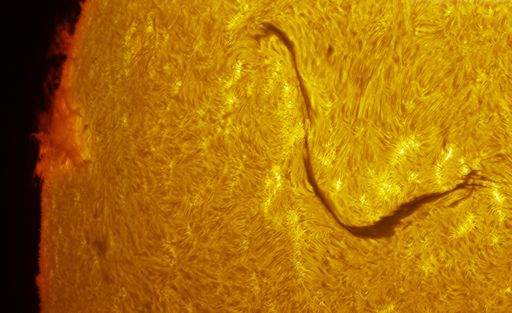
Astrophotograher Jack Newton photographed the structure on July 29th from his observatory in Osoyoos, British Columbia. Stretching more than 100,000 km from end to end, and filled with dense plasma, the sinuous filament is held aloft by solar magnetic fields. If it snaps or collapses and hits the stellar surface below, the result could be a Hyder flare--a type of explosion that does not require a sunspot.
NOAA forecasters estimate an increasing 25% chance of M-flares and a small but non-negligible 5% chance of X-flares on July 30th. Solar flare alerts: text, voice
Realtime Space Weather Photo Gallery