MINOR STORM WARNING: A CME is heading for Earth. The cloud was hurled into space on July 30th when a magnetic filament on the sun erupted, and it appears to be on course to sideswipe Earth's magnetic field. NOAA forecasters estimate a 30% chance of polar geomagnetic storms on Aug. 2nd when the CME arrives. Aurora alerts: text, voice

RADIO BURSTS FROM THE SUN: The loudspeakers of shortwave radios are bursting with static today. The source of the noise is the sun. "I have been picking up solar bursts on my RadioJove receiver at 20.1 MHz," reports Kevin Palivec of Hawley, Texas. This chart recording displays 10 minutes of activity:
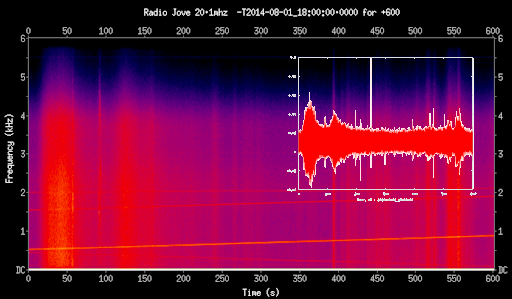
The bursts were triggered by an M2-class explosion in the magnetic canopy of sunspot AR2127. The explosion sent shock waves rippling through the sun's atmosphere. Those shock waves, in turn, excited plasma instabilities that emit static-y radio waves. Becase there are a whole variety of plasma instabilites, there is a corresponding variety of radio burst types. Palivec recorded a mix of two: Type II and Type IV.
More solar radio bursts could be in the offing as sunspot AR2127 and nearby sunspot AR2130 both crackle with M-class solar flares. Visit NASA's RadioJove website to find out how to build your own receiver--and listen up.
Realtime Space Weather Photo Gallery
FIVE DAYS TO THE ROSETTA COMET: ESA's Rosetta probe is now only five days away from a historic encounter with Comet 67P/Churyumov-Gerasimenko. If all goes as planned, Rosetta will become the first spacecraft to orbit a comet, follow it around the sun, and even drop a lander on its surface. Readers got a sneak preview yesterday when ESA released dramatic new images of the comet's core and atmosphere:

The comet's atmosphere or "coma" (left), is a mixture of gas and dust slowly evaporating away from the sun-warmed core (right). At the moment, the coma is diffuse and relatively calm. That's because the comet is still far from the sun, about 544 million kilometers away in the cold dark space between Mars and Jupiter. A year from now this could change, however, as the comet swings by the sun only 185 million kilometers away. Increased solar heating will liberate jets of dust and high-speed streamers of gas, swelling the coma into something larger and much more dangerous to the spacecraft.
Rosetta is meeting up with the comet now so that researchers can not only study how the comet warms up along its orbit and how activity develops, but also because it is much safer to learn how to operate in such a new environment when the activity is relatively low. Moreover, landing would be significantly more challenging next year when activity is expected to be much higher.
Only 5 days to rendezvous! Follow the action @ESA_Rosetta.