MINOR STORM WARNING: A CME is heading for Earth. The cloud was hurled into space on July 30th when a magnetic filament on the sun erupted, and it appears to be on course to sideswipe Earth's magnetic field. NOAA forecasters estimate a 30% chance of polar geomagnetic storms on Aug. 2nd when the CME arrives. Aurora alerts: text, voice

AMAZING NEW PHOTO OF THE ROSETTA COMET: Today, the ESA released a new image of Comet 67P/Churyumov-Gerasimenko as seen from the Rosetta probe only 1000 km away. It shows the rough surface of the comet's double nucleus in amazing detail:

The photo was taken on Aug. 1st at 02:48 UTC by Rosetta's OSIRIS Narrow Angle Camera. The dark spot near image-center is an artifact from the onboard CCD.
This new view heightens anticipation for August 6th when Rosetta reaches the comet and goes into orbit around it. Then we will see the strange double-core from point-blank range, and researchers can start to pick touchdown sites for Philae, a lander that will descend to the comet's surface in November.
Only 4 days to rendezvous! Follow the action @ESA_Rosetta.
PLANETS CROSSING AT NOON (UPDATED): This weekend, Jupiter and Mercury are in conjunction. Don't bother looking because the meeting takes place in the noontime sky. What human eyes cannot see, however, spacecraft can. Using an opaque disk to block the glare of the sun, the Solar and Heliospheric Observatory (SOHO) is monitoring the encounter:

At closest approach on August 2nd, the two bright planets will be less than 1o apart. If such an alignment occured at night, it would surely be headline news. At noon, its just spaceweather news. Join SOHO for a ringside seat.
Realtime Space Weather Photo Gallery
RADIO BURSTS FROM THE SUN: Yesterday, the loudspeakers of shortwave radios erupted with static. The source of the noise was the sun. "I have been picking up solar bursts on my RadioJove receiver at 20.1 MHz," reports Kevin Palivec of Hawley, Texas. This chart recording displays 10 minutes of activity on August 1st:
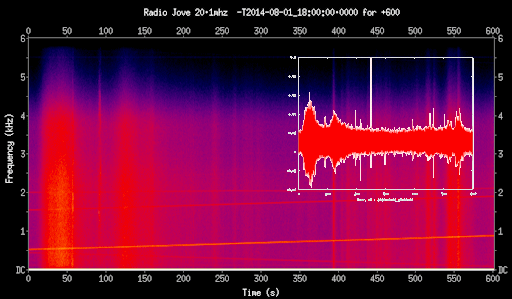
The bursts were triggered by an M2-class explosion in the magnetic canopy of sunspot AR2127. The explosion sent shock waves rippling through the sun's atmosphere. Those shock waves, in turn, excited plasma instabilities that emit static-y radio waves. Becase there are a whole variety of plasma instabilites, there is a corresponding variety of radio burst types. Palivec recorded a mix of two: Type II and Type IV.
More solar radio bursts could be in the offing as sunspot AR2127 and nearby sunspot AR2130 both crackle with M-class solar flares. Visit NASA's RadioJove website to find out how to build your own receiver--and listen up.
Realtime Space Weather Photo Gallery