COMET RENDEZVOUS--TODAY! The European Space Agency's Rosetta probe has reached 67P/Churyumov-Gerasimenko and is maneuvering to go into orbit around the comet's core. On approach, Rosetta's OSIRIS camera took this stunning picture from a distance of only 130 km:
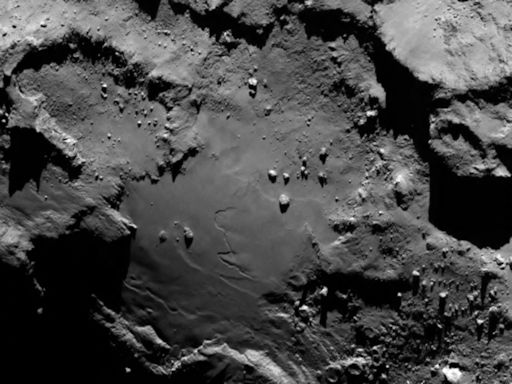
The image clearly shows a range of features including boulders, craters and steep cliffs. As the ESA science team noted this morning, "choosing a landing site will not be easy." More close-up shots may be found here.
Rosetta has reached the comet, but it is not in orbit yet. As this video shows, the spacecraft will spend the next month maneuvering closer and closer to the comet's core. When Rosetta dscends to within about 30 km of the surface in early September, the comet's weak gravity will be able to capture the spacecraft into a final orbit.
A full replay of today's historic event marking Rosetta's arrival at 67P is now available here: http://www.livestream.com/eurospaceagency
ROCKET LAUNCH PRODUCES NOCTILUCENT CLOUDS: On Tuesday morning, August 5th, a SpaceX Falcon 9 rocket lifted off from Cape Canaveral carrying the AsiaSat 8 telecommunications satellite. About an hour and a half after the 4 AM launch, electric-blue clouds appeared over Orlando FL:

"These clouds appeared just before sunrise," says photographer Mike Bartils.
These are, essentially, man-made noctilucent clouds (NLCs). Water vapor in the exhaust of the rocket crystallized in the high atmosphere, creating an icy cloud that turned blue when it was hit by the rays of the morning sun. Years ago, space shuttle launches produced similar displays.
Natural NLCs form around Earth's poles when water vapor in the mesosphere crystalizes around meteor smoke. Sometimes they spread as far south as Colorado and Utah, but rarely or never Florida. Electric-blue over the Sunshine State requires a rocket launch, and that's what happened today. Browse the realtime photo gallery for more images of the Falcon 9 launch:
Realtime Space Weather Photo Gallery
SPONSOR A SPACE WEATHER BALLOON: This Friday, the students of Earth to Sky Calculus will continue their ongoing campaign of high-altitude research with the launch of another Space Weather Radiation Buoy. The purpose of their research is to discover how solar activity affects the ozone layer and alters levels of radiation at altitudes of interest to space tourism. They are also launching microbes to find out which species can survive in space-like conditions. Readers who wish to support this exciting student-led work can sponsor the flight with an ad or message to be launched with the payload and displayed as shown:

For $500 the students will fly your message to the edge of space and return it to you along with complete video of the flight. Also, selected still shots will be displayed on spaceweather.com as part of our coverage of the event. Interested? Please email Dr. Tony Phillips for more information.