MOSTLY QUIET WITH A CHANCE OF FLARES: Sunspot AR2134 has a delta-class magnetic field that harbors energy for significant eruptions. However, like every other sunspot that has crossed the solar disk in recent weeks, this one seems reluctant to erupt. NOAA forecasters estimate only a 20% chance of M-flares during the next 24 hours as the month-long spell of low solar activty continues.
PERSEID METEOR UPDATE: The Perseid meteor rate continues to increase as Earth moves deeper into the debris stream of Comet Swift-Tuttle. Last night alone, NASA's network of all-sky cameras recorded 19 Perseid fireballs over the USA. That brings the total to 90 fireballs sighted since the shower began on July 26th. Bill Cooke of NASA's Meteoroid Environment Office has plotted the orbits of all 90 fireballs:

In this diagram of the inner solar system, Earth is the pale blue dot where all the Perseid orbits (green) intersect. The path of parent comet Swift-Tuttle is traced in purple, and it is a good match to the orbits of the Perseid debris.
"The brightest Perseid we've observed so far was magnitude -6.8," notes Cooke. "That's about as bright as a crescent Moon."
Observers hope that the Perseids will remain bright in the nights ahead because the Moon is waxing full. A supermoon on August 10th threatens to outshine many faint Perseids when the shower peaks. Science@NASA previews the competition in a new video: Perseids vs. the Supermoon.
HISTORIC COMET RENDEZVOUS: For the first time ever, a spacecraft from Earth is traveling alongside a comet. Yesterday, at the end of a 10 year and 6 billion km journey, the European Space Agency's Rosetta probe reached 67P/Churyumov-Gerasimenko. On approach, Rosetta's OSIRIS camera took this stunning picture of the comet's nucleus only 130 km away:
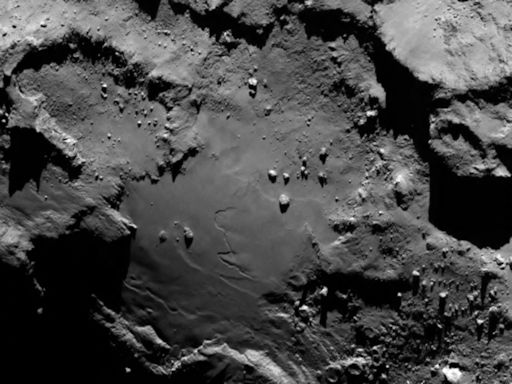
The image clearly shows a range of features including boulders, craters and steep cliffs. As the ESA science team noted this morning, "choosing a landing site will not be easy." More close-up shots may be found here.
Rosetta has reached the comet, but it is not in orbit yet. As this video shows, the spacecraft will spend the next month maneuvering closer and closer to the comet's core. When Rosetta dscends to within about 30 km of the surface in early September, the comet's weak gravity will be able to capture the spacecraft into a final orbit.
A full replay of Rosetta's arrival at 67P is now available here: http://www.livestream.com/eurospaceagency
SPONSOR A SPACE WEATHER BALLOON: This Friday, the students of Earth to Sky Calculus will continue their ongoing campaign of high-altitude research with the launch of another Space Weather Radiation Buoy. The purpose of their research is to discover how solar activity affects the ozone layer and alters levels of radiation at altitudes of interest to space tourism. They are also launching microbes to find out which species can survive in space-like conditions. Readers who wish to support this exciting student-led work can sponsor the flight with an ad or message to be launched with the payload and displayed as shown:

For $500 the students will fly your message to the edge of space and return it to you along with complete video of the flight. Also, selected still shots will be displayed on spaceweather.com as part of our coverage of the event. Interested? Please email Dr. Tony Phillips for more information.
Realtime Space Weather Photo Gallery