SPACE WEATHER BALLOON LAUNCH: This Friday, Aug. 8th, the students of Earth to Sky Calculus will continue their ongoing campaign of high-altitude research with the launch of another Space Weather Radiation Buoy. The purpose of the research is to discover how solar activity affects the ozone layer and alters levels of radiation at altitudes of interest to aviation and space tourism. Stay tuned for launch photos @spaceweatherman.
PERSEID FIREBALLS: The full Moon of August 10th is no ordinary full Moon--it's a supermoon, the biggest and brightest of 2014. This has raised concerns that bright moonlight will outshine the Perseid meteor shower, underway now as Earth moves into the debris stream of parent Comet Swift-Tuttle. So far the Perseids are holding their own. In recent nights, observers have reported dozens of Perseid fireballs cutting through the glare. This one, photographed by Thomas Ashcraft in New Mexico, came with sound effects:
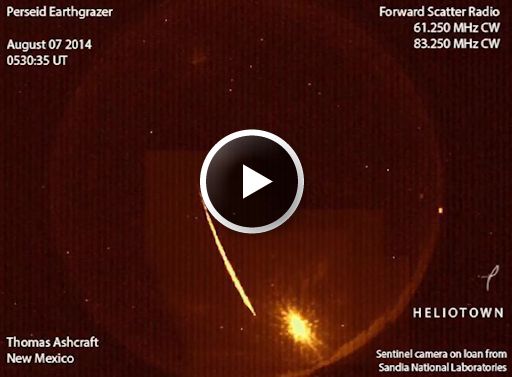
Play it again. The ghostly warbling sound you just heard was a terrestrial radio signal bouncing off the ionized trail of the fireball. This method of detecting meteors is called "forward scatter radar." Ashcraft, who is an amateur radio astronomer, routinely uses this method to monitor meteor activity over his observatory not far from Santa Fe. Lately, he has been recording lots of echoes.
"My radio fireball array and all-sky camera caught this Perseid earthgrazer at 11:30 pm here in New Mexico as the constellation Perseus was coming up over the northern horizon," says Ashcraft. "It caused a dynamic dopplering forward scatter reflection in stereo on two of my radios."
"Even though there is a bright moon at the moment, there will still be some beautiful Perseids over the next few nights," he predicts.
Got clouds? You can listen to more meteor echoes, live, on Space Weather Radio.
HISTORIC COMET RENDEZVOUS: For the first time ever, a spacecraft from Earth is traveling alongside a comet. Yesterday, at the end of a 10 year and 6 billion km journey, the European Space Agency's Rosetta probe reached 67P/Churyumov-Gerasimenko. On approach, Rosetta's OSIRIS camera took this stunning picture of the comet's nucleus only 130 km away:
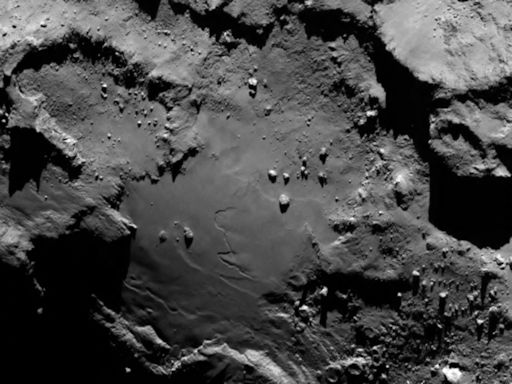
The image clearly shows a range of features including boulders, craters and steep cliffs. As the ESA science team noted this morning, "choosing a landing site will not be easy." More close-up shots may be found here.
Rosetta has reached the comet, but it is not in orbit yet. As this video shows, the spacecraft will spend the next month maneuvering closer and closer to the comet's core. When Rosetta dscends to within about 30 km of the surface in early September, the comet's weak gravity will be able to capture the spacecraft into a final orbit.
A full replay of Rosetta's arrival at 67P is now available here: http://www.livestream.com/eurospaceagency
Realtime Space Weather Photo Gallery