MORNING PLANETS: Set your alarm for dawn! Venus and Jupiter are converging for a spectacular conjunction in the early morning sky. Closest approach: August 18th. A video from NASA previews the encounter. [photo gallery]
ERUPTING FILAMENT CREATES 'CANYON OF FIRE', CME: A magnetic filament snaking down the middle of the solar disk erupted during the late hours of Aug. 15th. The eruption split the sun's atmosphere, hurling a CME toward Earth and creating a "canyon of fire," shown here in a movie recorded by the Solar Dynamics Observatory:
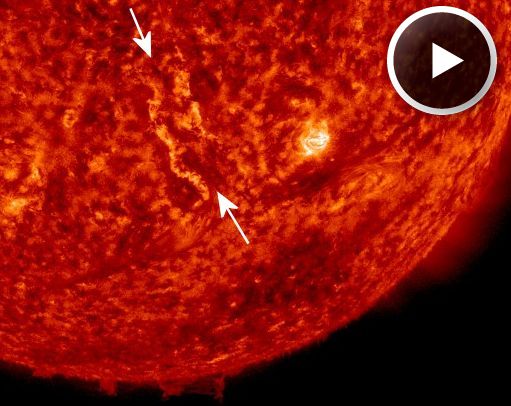
The glowing walls of the canyon trace the original channel where the filament was suspended by magnetic forces above the stellar surface. From end to end, the structure stretches more than 250,000 km--a real Grand Canyon.
Of greater interest to us on Earth is the coronal mass ejection (CME) which billowed away from the blast site: movie. Coronagraph images from the Solar and Heliospheric Observatory show that it is a 'halo CME.' In other words, it is heading straight for Earth. Minor geomagnetic storms are possible when the cloud arrives during the late hours of August 18th. High-latitude sky watchers should be alert for auroras. Aurora alerts: text, voice

Realtime Space Weather Photo Gallery
THE LANDSCAPE OF A COMET--NOW IN 3D: For the past few days, we have highlighted a recent image of Comet 67P/Churyumov-Gerasimenko taken by Europe's Rosetta spacecraft. Spaceweather.com reader Hanno Falk of Germany has taken that image to a new level by adding a 3rd dimension. Click on the graphic below, then cross your eyes to merge the two nuclei. Oh, and be careful not to fall over the cliff:

Falk created the cross-eyed view by combining two images taken by Rosetta 17 minutes apart. ESA did the same thing to make a 3D anaglyph. The problem with anaglyphs is that they require 3D glasses. Falk's version requires only two eyes.
The 3D view reveals a deep canyon separating the two lobes of 67P's core. The canyon's smooth floor is peppered with boulders, while the highlands outside the canyon are jagged and dimpled by crater-like depressions.
Now imagine this magnificent landscape ruptured by dozens of geysers spewing dust and gas into space. Future pictures may show exactly that. Rosetta will follow this comet for more than a year as it approaches the sun. In 2015, if not sooner, solar heating will activate the comet's icy core, creating a riot of activity the likes of which no spacecraft has ever seen before. Stay tuned for that.