CHANCE OF MINOR STORMS: NOAA forecasters estimate a 30% chance of polar geomagnetic storms on August 18th when a faint CME is expected to strike Earth's magnetic field head-on. This is not a major event. Nevertheless, high-latitude sky watchers should be alert for auroras when the CME arrives. Follow the action @spaceweatherman.

MORNING PLANETS: Did you see that? This morning Venus and Jupiter converged in the pre-dawn sky for a spectacular conjunction. At closest aproach they were barely 0.2o apart. Richard S. Wright Jr. sends this picture from Lake Mary, Florida:
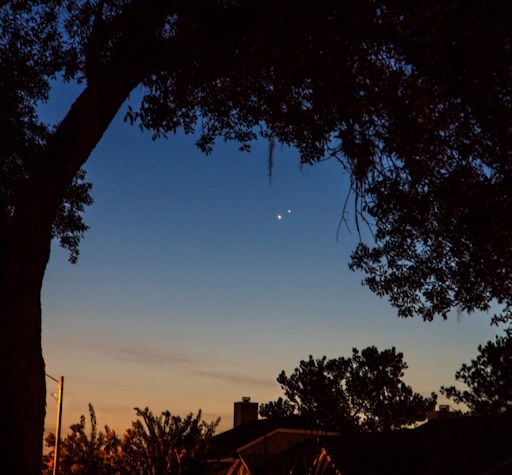
"This was worth setting my alarm for this morning," says Wright. "Jupiter and Venus were so close together, and rapidly rising as the sky brightened. I grabbed my tripod and caught them under my neighbors trees."
The planets are separating now, but not too quickly. They will still be a beautiful pair for the rest of the week. A date of special interest is August 23rd when the crescent Moon joins the planets to form a bright celestial triangle in the eastern pre-dawn sky.
Observing tips: Go outside 60 minutes before sunrise and look east-northeast. No telescope is required. Jupiter and Venus are bright enough to see with the naked eye even from light polluted cities. Try following the bright pair after the dawn sky begins to brighten. A tight conjunction of Venus and Jupiter framed by twilight blue is a great way to start the day. For more information, see this video from NASA.
Realtime Conjunction Photo Gallery
THE LANDSCAPE OF A COMET--NOW IN 3D: For the past few days, we have highlighted a recent image of Comet 67P/Churyumov-Gerasimenko taken by Europe's Rosetta spacecraft. Spaceweather.com reader Hanno Falk of Germany has taken that image to a new level by adding a 3rd dimension. Click on the graphic below, then cross your eyes to merge the two nuclei. Oh, and be careful not to fall over the cliff:

Falk created the cross-eyed view by combining two images taken by Rosetta 17 minutes apart. ESA did the same thing to make a 3D anaglyph. The problem with anaglyphs is that they require 3D glasses. Falk's version requires only two eyes.
The 3D view reveals a deep canyon separating the two lobes of 67P's core. The canyon's smooth floor is peppered with boulders, while the highlands outside the canyon are jagged and dimpled by crater-like depressions.
Now imagine this magnificent landscape ruptured by dozens of geysers spewing dust and gas into space. Future pictures may show exactly that. Rosetta will follow this comet for more than a year as it approaches the sun. In 2015, if not sooner, solar heating will activate the comet's icy core, creating a riot of activity the likes of which no spacecraft has ever seen before. Stay tuned for that.