MINOR GEOMAGNETIC STORM: A minor (G1-class) geomagnetic storm is underway as Earth passes through the wake of a CME that arrived on August 19th. "Here is a shot taken right now that shows the first aurora for the season over Östersund, Sweden," reports photographer Göran Strand:
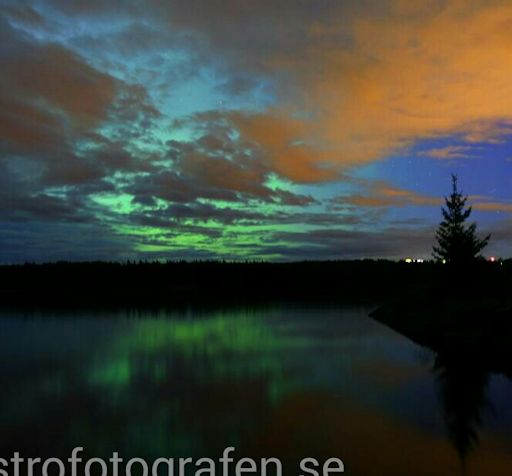
Although this is not a strong geomagnetic storm, it could produce beautiful auroras for high-latitude sky watchers in Europe, Iceland, Greenland, and North America. The best time to look is during the hours around local midnight. Aurora alerts: text, voice
MORNING SHOW CONTINUES: Set your alarm for dawn. Venus and Jupiter are putting on a fantastic show in the early morning sky. At daybreak on Tuesday, August 19, Marek Nikodem caught the planets rising over Szubin, Poland:
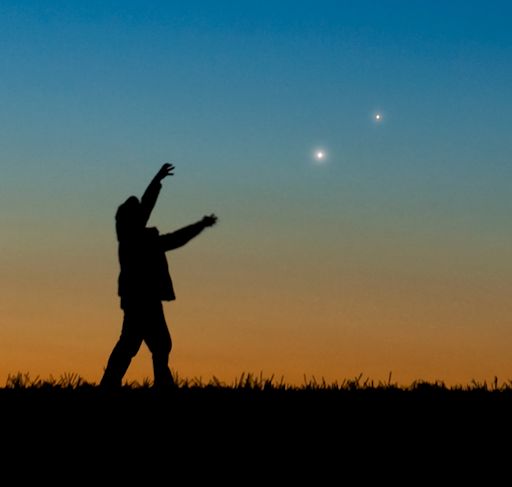
"It was a beautiful celestial dawn," says Nikodem, "definitely worth waking up for."
Following their 0.2o near-miss on Monday, August 18th, Venus and Jupiter are separating, but not too quickly. They'll remain in the same patch of sunrise sky for the rest of the week. A date of special interest is August 23rd when the crescent Moon joins the planets to form a must-see celestial triangle. A video from NASA previews the meeting.
Realtime Conjunction Photo Gallery
THE SURPRISING POTENCY OF "WEAK" FLARES: For the past month, the sun has been mostly quiet with only a smattering of C- and B-class solar flares. As flares go, these are puny. In fact, when the sun is crackling with flares no stronger than B-class, we often say that "solar activity is very low."
But is it, really? A B-class solar flare packs a bigger punch than is generally supposed. Consider this specimen photographed by Harald Paleske of Weißenfels/ OT Langendorf, Germany, on August 17th:
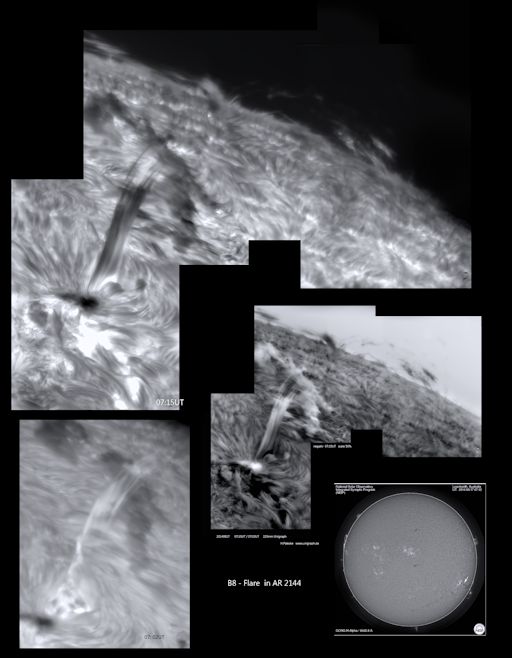
"This was a B8-class flare in sunspot AR2144," says Paleske. "Despite poor seeing, I was able to capture a high-resolution view of the explosion using my 225mm Unigraph solartelescope."
The violence frozen in these snapshots belies the idea that this was a weak explosion. And indeed it was not. A typical B-class solar flare releases as much energy as 100 million WWII atomic bombs. Only on the sun, which is itself a 1027 ton self-contained nuclear explosion, would such a blast be considered puny.
So the next time you hear that the forecast calls for "low solar activity," remember ... everything is relative. Today's forecast, by the way, calls for low solar activity with only a 10% chance of M-class solar flares.