GEOMAGNETIC STORM, AURORAS SEEN FROM SPACE: A moderate (G2-class) geomagnetic storm that erupted following a CME strike on August 19th is subsiding now. At its peak, the storm sparked auroras around both poles visible from the ground and from space. Astronaut Reid Wiseman took this picture from the window of the International Space Station:
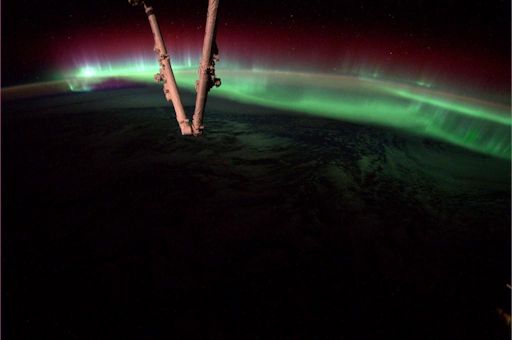
"Never in my wildest dreams did I imagine this," tweeted Wiseman (@astro_reid). "Unbelievable."
Around the Arctic Circle where the midnight sun has overwhelmed auroras since Spring, observers caught their first glimpse of Northern Lights in months "At one point a massive corona unfolded just over my head!" reports Alexander Kuznetsov from the Finnish Lapland. "It was a great season opener," added Pekka Hyytinen of Tampere, Finland. "I also caught a lightning strike in one of my photos."
Solar wind conditions are unsettled but calming as Earth passes through the wake of the CME. NOAA forecasters estimate a waning 30% to 15% chance of more geomagnetic storms during the next 24 hours. Aurora alerts: text, voice
MORNING SHOW CONTINUES: Light pollution? No problem. The morning conjunction of Venus and Jupiter is bright enough to see through the worst urban glare. Jeff Dai sends this picture from metropolitan Chongqing, China:
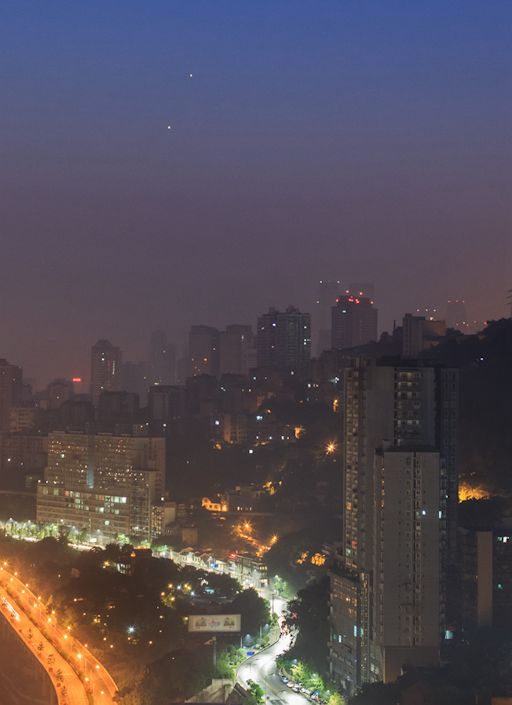
"I woke up at 5 AM to enjoy this celestial dawn above the cityscape," says Dai. "It was gorgeous."
Dai took the picture on August 20th, two days after Venus and Jupiter were barely 0.2o apart. Many observers have stopped looking now that the planets are separating, but as Dai's photo shows, they are still a beautiful pair. So set your alarm for dawn: the morning show continues. A date of special interest is August 23rd when the crescent Moon joins the planets to form a must-see celestial triangle. A video from NASA previews the meeting.
Realtime Conjunction Photo Gallery
THE POTENCY OF "WEAK" FLARES: For the past month, the sun has been mostly quiet with only a smattering of C- and B-class solar flares. As flares go, these are puny. In fact, when the sun is crackling with flares no stronger than B-class, we often say that "solar activity is very low."
But is it, really? A B-class solar flare packs a bigger punch than is generally supposed. Consider this specimen photographed by Harald Paleske of Weißenfels/ OT Langendorf, Germany, on August 17th:
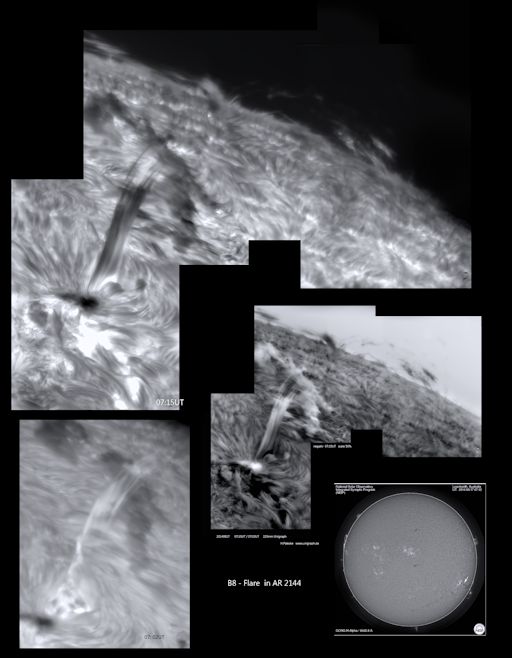
"This was a B8-class flare in sunspot AR2144," says Paleske. "Despite poor seeing, I was able to capture a high-resolution view of the explosion using my 225mm Unigraph solartelescope."
The violence frozen in these snapshots belies the idea that this was a weak explosion. And indeed it was not. A typical B-class solar flare releases as much energy as 100 million WWII atomic bombs. Only on the sun, which is itself a 1027 ton self-contained nuclear explosion, would such a blast be considered puny.
So the next time you hear that the forecast calls for "low solar activity," remember ... everything is relative. Today's forecast, by the way, calls for low solar activity with only a 10% chance of M-class solar flares.