MYSTERY IN THE OZONE LAYER: More than 27 years after the Montreal Protocol regulated chemicals that destroy ozone, a damaging compound named carbon tetrachloride (CCl4) is still surprisingly abundant in the ozone layer. "We are not supposed to be seeing this at all," says NASA atmospheric scientist Qing Liang. Countries around the world report zero emissions of CCl4, yet the amount actually in the ozone layer corresponds to 39 kilotons per year. Where is the compound coming from? Some of the possibilities are discussed in a NASA press release.
WEAK IMPACT? MAGNIFICENT AURORAS: Visually, the CME that struck Earth's magnetic field on August 19th was dim and unimpressive. The auroras it produced were magnificent. "For the first time in my life, I saw the Northern Lights," says Tadas Janušonis who sends this photo from Vabalninkas, Lithuania:


"It is a very rare phenomenon here in Lithuania," he says, "but the August 19th impact was strong enough to [produce] them."
Actually, the impact was weak. A CME like this one hits with a mechanical pressure of no more than 1 or 2 nanoPascals. That's 1 or 2 billionths of a Pascal - softer than a baby's breath. The reason it was so effective had more to do with its inner magnetic structure. This CME contained a region of south-pointing magnetism that partially canceled Earth's north-pointing magnetic field, opening a crack in the magnetosphere. Solar wind poured and fueled the display.
The most famous photo of the storm, so far, was taken by astronaut Reid Wiseman onboard the International Space Station. "Never in my wildest dreams did I imagine this, " he tweeted. "Unbelievable." Yet many more photos prove that it really did happen! Aurora alerts: text, voice
MORNING SHOW CONTINUES: Light pollution? No problem. The morning conjunction of Venus and Jupiter is bright enough to see through the worst urban glare. Jeff Dai sends this picture from metropolitan Chongqing, China:
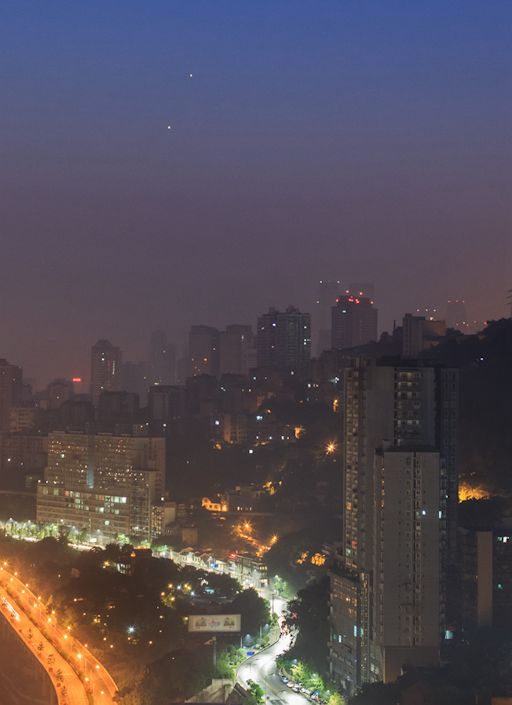
"I woke up at 5 AM to enjoy this celestial dawn above the cityscape," says Dai. "It was gorgeous."
Dai took the picture on August 20th, two days after Venus and Jupiter were barely 0.2o apart. Many observers have stopped looking now that the planets are separating, but as Dai's photo shows, they are still a beautiful pair. So set your alarm for dawn: the morning show continues. A date of special interest is August 23rd when the crescent Moon joins the planets to form a must-see celestial triangle. A video from NASA previews the meeting.
Realtime Conjunction Photo Gallery