MINOR STORM WARNING: NOAA forecasters estimate a 15%-20% chance of polar geomagnetic storms on Aug. 26-27 in response to an incoming CME. Launched on Aug 22nd, the storm cloud is a relatively slow-moving one, so strong storms are not likely. Even so, Arctic sky watchers should be alert for auroras. Aurora alerts: text, voice
COMET CANDIDATE LANDING SITES SELECTED: Working over the weekend, Rosetta mission planners and scientists narrowed a list of 10 candidate landing sites to only 5. They are circled in this image of the core of 67P/Churyumov-Gerasimenko:
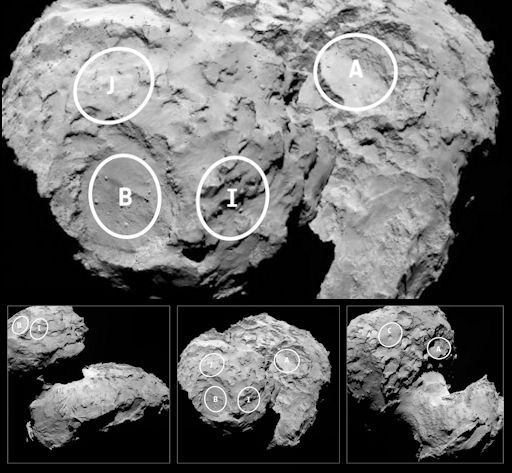
In mid-November, Rosetta's Philae lander will attempt to touch down in one of these locations--the first time humankind has ever landed a probe on the core of a comet.
The candidate sites are distributed as follows: three (I, B and J) on the comet's smaller lobe and two (A and C) on the larger. The comet's canyon-like neck has been excluded. All of the candidate landing sites provide at least six hours of daylight per comet rotation and offer some flat terrain. According to the ESA, every site has the potential for unique scientific discoveries by the lander's 10 instruments.
A full discussion of each site may be found in this ESA press release. By September 14th, the five candidates will have been assessed and ranked, leading to the selection of a primary landing site, for which a fully detailed strategy for the landing operations will be developed, along with a backup. Stay tuned for updates as the selection process unfolds.
CMEs MISS EARTH: Yesterday, Aug. 25th, active sunspot AR2148 erupted twice, producing a rapidfire pair of M-class solar flares (M2 @ 1511 UT and M3 @ 2021 UT). The Solar and Heliospheric Observatory recorded a corresponding pair of CMEs emerging from the blast site:

According to NOAA analysts, the first CME does not have an Earth-directed component. The second CME looks even less Earth-directed than the first. In short, they missed.
More eruptions may be in the offing. Sunspots AR2146 and AR2149 both have complex magnetic fields that harbor energy for strong flares. NOAA forecasters estimate a 55% chance of M-class flares and 10% chance of X-flares on August 26th. Follow the action @spaceweatherman
Realtime Space Weather Photo Gallery
STRATOSPHERIC SPACE WEATHER BUOY: Have you ever wondered what a lunchbox suspended 112,000 feet above Earth's surface would look like? The answer is, this:

This is actually a Space Weather Buoy--a lunchbox containing a cosmic ray detector, cameras, GPS trackers, a thermometer and other sensors. It flew to the stratosphere on August 22nd tethered to a suborbital helium balloon. In collaboration with Spaceweather.com, the students of Earth to Sky Calculus have been launching these buoys on a regular basis to study the effect of solar activity on Earth's upper atmosphere. Soon, they will release results from a year-long campaign covering altitudes of interest to aviation, space tourism, and ozone research.
The students wish to thank Eden Botanicals for sponsoring the August 22nd flight. (Note their logo on the corner of the payload.) This was the student group's 58th successful launch--almost all paid for by a combination of donations and commercial advertising.

Readers, would you like to sponsor the next flight of the Space Weather Buoy? For only $500 you can send your logo to the edge of space and help students continue their explorations of the stratosphere. Contact Dr. Tony Phillips for more information.