CHANCE OF FLARES: NOAA forecasters estimate a 40% chance of M-class flares and a 5% chance of X-flares on Aug. 28th. The likely source is sunspot AR2146, which has a 'beta-gamma-delta' magnetic field that harbors energy for strong eruptions. The geoeffectiveness of any flares from this region will be mitigated, however, by its off-center location on the solar disk. Solar flare alerts: text, voice
GEOMAGNETIC ACTIVITY: Earth's magnetic field is still reverberating from a pair of CME strikes on August 27th. Although neither impact was particularly strong, the internal magnetic structure of the two solar storm clouds was just right for auroras. Last night, Alan Dyer photographed the display over the Grasslands National Park in Saskatchewan, Canada. Click to view a complete panorama:

"I shot this at the old pioneer Larson Ranch site in the Frenchman River valley just as the magnetic storm of Aug 27/28 hit its peak, covering much of the northern sky and lighting the ground and ranch buildings green," says Dyer. "The Larsons ran their ranch from the 1920s until 1985 when theirs became first land to be bought for the new Grasslands National Park. This is a stitch of 8 segments, each shot with the 15mm full-frame fish-eye lens at f/3.2 and Canon 6D at ISO 2500 for 1 minute each."
The CMEs that instigated the display were launched toward Earth on Aug. 22nd. As NOAA analysts predicted, the solar wind speed did not change much when the slow-moving CMEs arrived. However, the storm clouds were still effective because they contained a south-pointing magnetic field that opened a crack in Earth's magnetosphere. Solar wind poured in to fuel the show.
High-latitude sky watchers, if it is dark where you live, remain alert for auroras. Solar wind conditions continue to favor geomagnetic activity as August 28th unfolds. Aurora alerts: text, voice
TWILIGHT TRIANGLE: Go outside just after sunset and look southwest. Something there will make you do a double-take. Mars and Saturn have converged alongside the second brightest star in Libra to form a pretty twilight triangle:
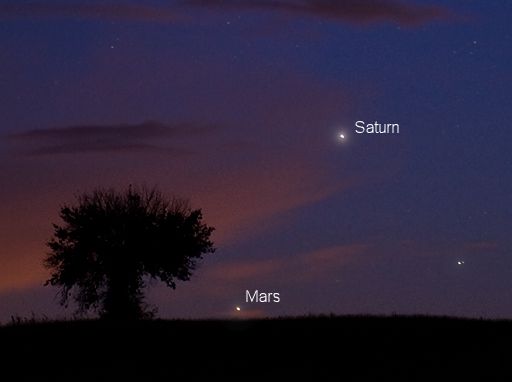
"It was an amazing triangle," says photographer Marek Nikodem of Szubin, Poland. The planets are labeled in Nikodem's photo, but that star is not. That's because its name wouldn't fit. The second brightest star in Libra is Zubenelgenubi. Pronounced "zoo-BEN-el-je-NEW-bee," it is a double star 77 light years from Earth easily split by binoculars or a small backyard telescope.
Soon, the threesome will become a foursome. The crescent Moon will pass through the triangle on August 30th and 31st. On those evenings, in the time it takes to scan your telescope around a small patch of sky, you can see a double star, the rings of Saturn, the red disk of Mars, and the cratered landscape of the Moon. Mark your calendar!
Realtime Space Weather Photo Gallery