COMET LANDING SITE SLIDESHOW: In mid-November, ESA's Rosetta spacecraft will make history by dropping a probe onto the surface of a comet. Bristling with 10 sensors including a camera, the Philae lander will touchdown somewhere on the rugged double-lobed core of comet 67P/Churyumov-Gerasimenko. But where? A new slideshow previews 5 candidate landing sites.
AURORAS EXPLODE THROUGH ARCTIC TWILIGHT: "After a long summer without stars, the Northern Lights have finally returned," reports Fredrik Broms of Tromsø, Norway (70 deg N latitude). "Last night's display was so strong that, although constellations such as Cassiopeia are still only to be made out very faintly on the blue night sky, the auroras shimmered and danced in an explosion of colors!" This is what he saw almost directly overhead around local midnight on August 28th:

The twilight display was sparked by a pair of CME impacts on August 27th. As Earth passed through the wake of the storm clouds, the interplanetary magnetic field (IMF) around Earth tipped south. This opened a crack in our planet's magnetosphere; solar wind poured in to fuel a light show that lasted for nearly three days and nights.
NOAA forecasters estimate a 20% chance of polar geomagnetic storms on Aug. 29th as CME effects wane. Arctic sky watchers should remain alert for green in the twilight. Aurora alerts: text, voice
TWILIGHT TRIANGLE: Go outside just after sunset and look southwest. Something there will make you do a double-take. Mars and Saturn have converged alongside the second brightest star in Libra to form a pretty twilight triangle:
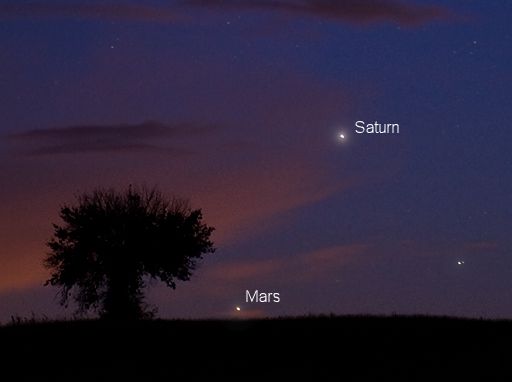
"It was an amazing triangle," says photographer Marek Nikodem of Szubin, Poland. The planets are labeled in Nikodem's photo, but that star is not. That's because its name wouldn't fit. The second brightest star in Libra is Zubenelgenubi. Pronounced "zoo-BEN-el-je-NEW-bee," it is a double star 77 light years from Earth easily split by binoculars or a small backyard telescope.
Soon, the threesome will become a foursome. The crescent Moon will pass through the triangle on August 30th and 31st. On those evenings, in the time it takes to scan your telescope around a small patch of sky, you can see a double star, the rings of Saturn, the red disk of Mars, and the cratered landscape of the Moon. Mark your calendar!
Realtime Space Weather Photo Gallery