EVENING PLANETS: Tonight, after sunset, step outside and look southwest. The Moon, Mars and Saturn have gathered in the constellation Libra, forming a pretty triangle of heavenly lights. It's a nice way to end the day. [sky map]

ARCTIC AURORAS: After a long, long summer day, Arctic skies are darkening again, and in the sunset observers are seeing rays of green in the twilight blue. Frank Olsen of Sortland, Norway, took this picture at sunset on Aug. 31st:

"I went out last night to catch the sunset--but mostly the auroras," says Olsen. "Even before it was dark, the Northern Lights made an appearance."
More lights are in the offing. NOAA forecasters estimate a 20% of polar geomagnetic storms during the next 24 hours. The odds of Arctic auroras are higher, however, because it doesn't take a full-fledged storm to turn the twilight green at polar latitudes. Now is a good time to book a tour. Aurora alerts: text, voice
RED SPRITES AND GREEN GRAVITY WAVES: As northern summer comes to a close, electrical storms are rumbling across the USA. After nightfall, red sprites can be seen dancing across the cloudtops. On Aug. 20th, Tom A. Warner photographed these specimens above New Underwood, South Dakota:
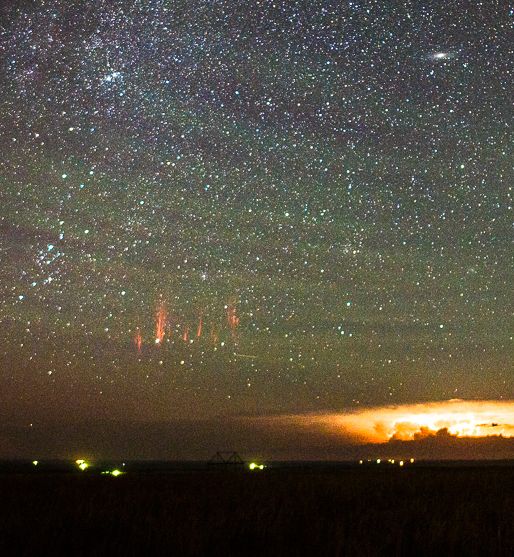
"On the night of Aug 20th, intense storms developed in north central South Dakota," says Warner. "Skies cleared out to the west and offered a chance to capture some sprites from the northern activity."
He saw not only sprites, but also green-glowing gravity waves. The waves are, literally, the ripple effect of a powerful thunderstorm on the mesosphere some 80 km above Earth's surface. From space, these waves look like a giant atmospheric bull's eye. From the ground, they appear to be green ripples in the sky, as shown in Warner's images.
Left to themselves, gravity waves would be invisible to the human eye. We see them, however, because they are colored green by an aurora-like phenomenon called "airglow." Airglow is caused by an assortment of chemical reactions in the upper atmosphere driven mainly by solar ultraviolet radiation. Gravity waves rippling away from the central axis of a thunderstorm cause temperature and density perturbations in the upper atmosphere. Speaking simplistically, those perturbations alter the chemical reaction rates of airglow, leading to more-bright or less-bright bands depending on whether the rates are boosted or diminished, respectively.
Inhabiting the upper reaches of Earth's atmosphere alongside meteors, noctilucent clouds and some auroras, sprites and mesospheric gravity waves are true space weather phenomena. Now is a good time to see them.
MARS COMET PASSES STAR CLUSTER: Comet Siding Spring (C/2013 A1) is hurtling toward Mars for a near miss on Oct. 19, 2014. En route, a different near miss occured. On Aug. 28, the "Mars Comet" pass almost directly in front of globular star cluster NGC 362:

"I took the picture shortly after minimum separation between the two," says astrophotographer Damian Peach of Selsey, UK.
Less than two months from now the comet will reach Mars. Although the comet's nucleus will not strike the planet, gas and dust spewing out of the comet's core will likely interact with the Martian atmosphere. There could be a meteor shower, auroras, and other effects that no one can predict. NASA's fleet of Mars spacecraft and rovers will record whatever happens.
Amateur astronomers can monitor the comet's approach to Mars in the months ahead. Right now, Siding Spring is gliding through the southern constellation Tucana glowing about as brightly as a 11th magntitude star. Mid-sized telescopes such as the Comet Hunter equipped with CCD cameras should have no trouble picking it up. [light curve] [ephemeris] [3D orbit]
Realtime Space Weather Photo Gallery