FILAMENT ERUPTION, POSSIBLY EARTH-DIRECTED: For days, amateur astronomers around the world have been monitoring an enormous filament of dark plasma snaking across the face of the sun. Today it erupted. A movie from NASA's Solar Dynamics Observatory seems to show debris from the blast hurtling in the general direction of Earth. Stay tuned for coronagraph data, which could confirm or refute an Earth-directed CME.
SIGNIFICANT FARSIDE FLARE: A sunspot located just behind the sun's northeastern limb exploded yesterday, Sept. 1st @ 1105 UT, producing "a significant solar flare," according to NOAA analysts. NASA's STEREO-B spacecraft, stationed over the farside of the sun, recorded the extreme ultraviolet flash.:

A fast CME emerged from the blast site traveling approximately 2000 km/s (4.5 million mph): movie. The flare also produced strong radio bursts and a farside solar proton storm. Only the intervening limb of the sun prevented potentially-strong Earth effects.

When flares occur on the Earthside of the sun, we classify them according to their X-ray intensity: C (weak), M (medium), or X (strong). Farside explosions, however, cannot be precisely classified because none of the spacecraft stationed over the farside of the sun are equipped with X-ray sensors. The appearance of the flare at UV wavelengths, plus other factors such as the CME and radiation storm, suggests that this was an X-class event.
Soon, the source of the explosion will reveal itself as solar rotation carries it up and over the sun's NE limb. Earth-directed solar activity could be just a few days away. Solar flare alerts: text, voice
Realtime Space Weather Photo Gallery
NOCTILUCENT CLOUD SEASON ENDS: Data from NASA's AIM spacecraft suggest that the northern summer season for noctilucent clouds (NLCs) has ended. "We'll have to wait for the definitive processing to determine for certain the last day of the northern 2014 season, but I think it was probably 26 August," says AIM science team member Cora Randall of the Laboratory for Atmospheric and Space Physics in Boulder, CO. Click to view a video racap of the season:
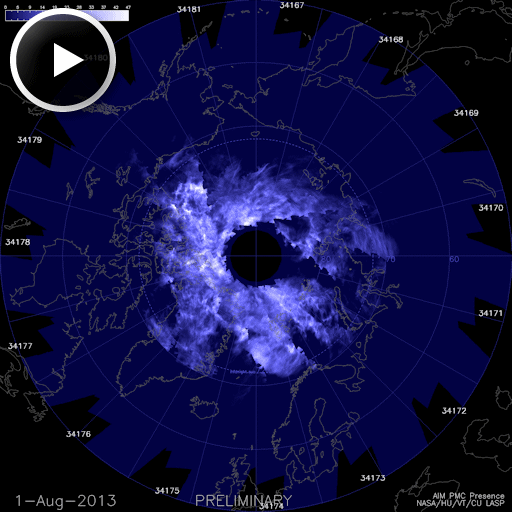
NLCs are Earth's highest clouds. Seeded by "meteor smoke," they form at the edge of space 83 km above Earth's surface. When sunlight hits the tiny ice crystals that make up these clouds, they glow electric blue.
NLCs appear during summer because that is when water molecules are wafted up from the lower atmosphere to mix with the meteor smoke. That is also, ironically, when the upper atmosphere is coldest, allowing the ice crystals of NLCs to form. Because they are a summertime phenomenon, NLCs switch back and forth between the hemispheres--northern in May through August, southern in November through February.
The "noctilucent daisy" shown on Spaceweather.com will probably remain blank until November when NLC activity normally shifts to the southern hemisphere. Stay tuned for more electric blue ... in a few months.
RED SPRITES AND GREEN GRAVITY WAVES: As northern summer comes to a close, electrical storms are rumbling across the USA. After nightfall, red sprites can be seen dancing across the cloudtops. On Aug. 20th, Tom A. Warner photographed these specimens above New Underwood, South Dakota:
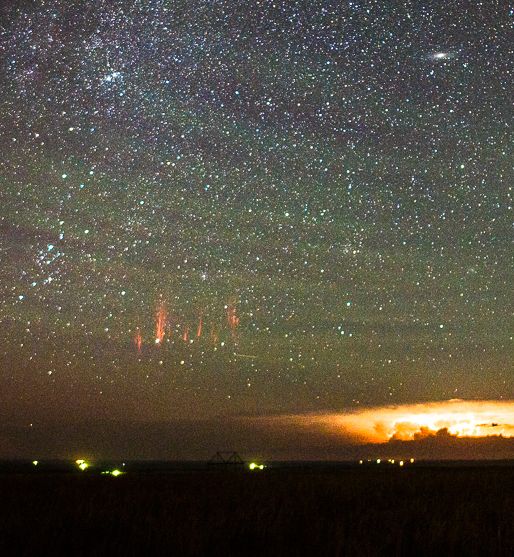
"On the night of Aug 20th, intense storms developed in north central South Dakota," says Warner. "Skies cleared out to the west and offered a chance to capture some sprites from the northern activity."
He saw not only sprites, but also green-glowing gravity waves. The waves are, literally, the ripple effect of a powerful thunderstorm on the mesosphere some 80 km above Earth's surface. From space, these waves look like a giant atmospheric bull's eye. From the ground, they appear to be green ripples in the sky, as shown in Warner's images.
Left to themselves, gravity waves would be invisible to the human eye. We see them, however, because they are colored green by an aurora-like phenomenon called "airglow." Airglow is caused by an assortment of chemical reactions in the upper atmosphere driven mainly by solar ultraviolet radiation. Gravity waves rippling away from the central axis of a thunderstorm cause temperature and density perturbations in the upper atmosphere. Speaking simplistically, those perturbations alter the chemical reaction rates of airglow, leading to more-bright or less-bright bands depending on whether the rates are boosted or diminished, respectively.
Inhabiting the upper reaches of Earth's atmosphere alongside meteors, noctilucent clouds and some auroras, sprites and mesospheric gravity waves are true space weather phenomena. Now is a good time to see them.