SOMETHING IN THE OFFING: On Sept. 1st a very powerful eruption occured just beyond the sun's northeastern limb and then, today, Earth-orbiting satellites detected an M2-class flare (movie) from a sunspot emerging over the southeastern limb. It appears that at least two active regions will be turning toward Earth in the days ahead. Stay tuned for increasing solar activity. Solar flare alerts: text, voice
FILAMENT ERUPTION, EARTH-DIRECTED: Yesterday, Sept. 2nd, an enormous filament of dark plasma, which had been snaking across the face of the sun for days, became unstable and erupted. NASA's Solar Dynamics Observatory recorded the event (movies: #1, #2). A CME emerging from the blast site appears to have an Earth-directed component:

According to NOAA analysts, the CME could deliver a glancing blow to Earth's magnetic field on Sept. 6th. This is not a particularly fast or powerful CME. Nevertheless, the coming impact could spark auroras. The last two minor CMEs that struck Earth in late August triggered beautiful displays of Northern and Southern Lights. The reason: it's aurora season. High-latitude sky watchers should prepare for Sept. 6th. Aurora alerts: text, voice
RED SPRITES AND GREEN GRAVITY WAVES: As northern summer comes to a close, electrical storms are rumbling across the USA. After nightfall, red sprites can be seen dancing across the cloudtops. On Aug. 20th, Tom A. Warner photographed these specimens above New Underwood, South Dakota:
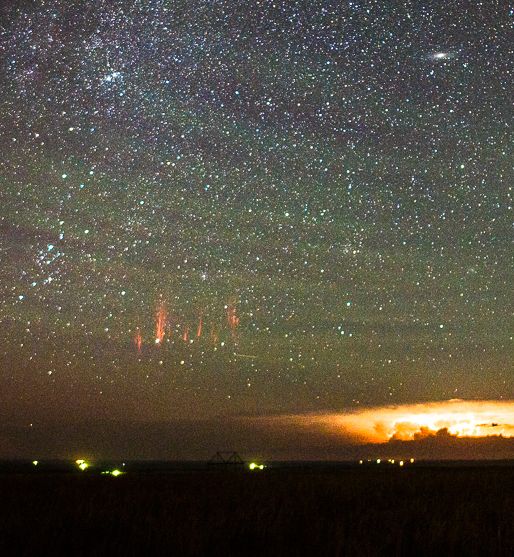
"On the night of Aug 20th, intense storms developed in north central South Dakota," says Warner. "Skies cleared out to the west and offered a chance to capture some sprites from the northern activity."
He saw not only sprites, but also green-glowing gravity waves. The waves are, literally, the ripple effect of a powerful thunderstorm on the mesosphere some 80 km above Earth's surface. From space, these waves look like a giant atmospheric bull's eye. From the ground, they appear to be green ripples in the sky, as shown in Warner's images.
Left to themselves, gravity waves would be invisible to the human eye. We see them, however, because they are colored green by an aurora-like phenomenon called "airglow." Airglow is caused by an assortment of chemical reactions in the upper atmosphere driven mainly by solar ultraviolet radiation. Gravity waves rippling away from the central axis of a thunderstorm cause temperature and density perturbations in the upper atmosphere. Speaking simplistically, those perturbations alter the chemical reaction rates of airglow, leading to more-bright or less-bright bands depending on whether the rates are boosted or diminished, respectively.
Inhabiting the upper reaches of Earth's atmosphere alongside meteors, noctilucent clouds and some auroras, sprites and mesospheric gravity waves are true space weather phenomena. Now is a good time to see them.
Realtime Space Weather Photo Gallery