CHANCE OF STORMS: NOAA forecasters estimate a 25% chance of polar geomagnetic storms on Sept. 6th when a CME is expected to deliver a glancing blow to Earth's magnetic field. High-latitude sky watchers should be alert for auroras. Aurora alerts: text, voice
VOLCANIC MOONSET + AURORAS: A few days ago, pilot Brian Whittaker was flying over Iceland when he saw a strange plume poking through the cloudtops. "It was the active fissure eruption of Holuhraun associated with the nearby Bardarbunga Volcano," he explains. "Air traffic control reported it actively erupting to the north of the giant Vatnajokull Glacier and Grimsvotn Volcano which closed European airspace back in 2011."
Last night Whittaker flew over the area again, in the dark, and this time he witnessed a very different scene:
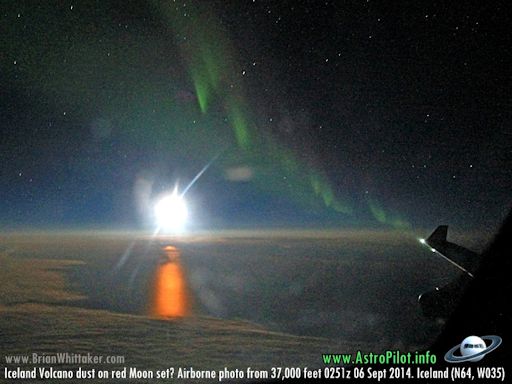 .
"About 500 miles southwest of Iceland I recognized a much redder then usual Moon set, especially with its reflection upon the ocean below," he says. "I strongly suspect that it was caused by the recent releases of volcanic dust and aerosols from Iceland."
Whittaker also saw a band of green auroras slashing across the sky, a possible preview of the weekend ahead. A CME is expected to sideswipe Earth's magnetic field on Sept. 6th, sparking Arctic auroras visible through the dust. Aurora alerts: text, voice
MORE ASTEROID NEWS: While 2014 RC grabs headlines this weekend by flying under Earth's belt of geosynchronous satellites (see the news item below), astronomers are training their telescopes on another, weirder asteroid also in Earth's neighborhood. 2002 CE26 is a binary asteroid consisiting of a primary space rock 3.5 km in diameter and a secondary approximately one-tenth as wide. What's weird is, radar data suggest that the secondary space rock might have a moon of its own. Alberto Quijano Vodniza of the University of Narino Observatory in Colombia photographed the triple system streaking through the constellation Pegasus on Sept. 2nd:

At closest approach on Sept. 9th, 2002 CE26 will be 18.4 million km (0.123 AU) from Earth. That is relatively far away, but because of the asteroid's large size, it is still possible to obtain meaningful data from the flyby. NASA astronomers will be pinging the system using the Goldstone radar in the Mojave desert. The Goldstone team says "we should be able to get coarse-resolution images of the primary. Echoes from the secondary will be weak and on the edge of detectability."
They also encourage experienced amateur astronomers to monitor the flyby: "This object should reach 14th magnitude while at favorable solar elongations, so it should be an excellent target for lightcurves. Lightcurves might detect the signature of at least one satellite and could help refine the orbital period." [3D orbit] [ephemeris]
Realtime Space Weather Photo Gallery
WEEKEND ASTEROID FLYBY: This Sunday, a house-sized asteroid named "2014 RC" will fly through the Earth-Moon system almost inside the orbit of geosynchronous satellites. At closest approach, Sept. 7th at 18:18 UTC, the 20-meter-wide space rock will pass just 40,000 km over New Zealand. This diagram from NASA shows the geometry of the encounter:

There is no danger of a collision with Earth.
Asteroid 2014 RC was discovered on the night of August 31 by the Catalina Sky Survey near Tucson, Arizona, and independently detected the next night by the Pan-STARRS 1 telescope, located on the summit of Haleakalā on Maui, Hawaii. Follow-up observations quickly confirmed the orbit of 2014 RC: it comes from just beyond the orbit of Mars.
The close appproach of this space rock offers researchers an opportunity for point-blank studies of a near-Earth asteroid. Even amateur astronomers will be able to track it. Around the time of closest approach, it will brighten to magnitude +11.5 as it zips through the constellation Pisces. This means it will be invisible to the naked eye but a relatively easy target for backyard telescopes equipped with CCD cameras. [ephemeris] [3D orbit]
According to NASA, "[the orbit of 2014 RC] will bring it back to our planet's neighborhood in the future. The asteroid's future motion will be closely monitored, but no future threatening Earth encounters have been identified."