METEORITE SKEPTICISM: Reports are circulating of a meteorite strike in Nicaragua on Sunday, Sept. 7th. Because the timing coincides with the flyby of asteroid 2014 RC, some reporters have suggested a link. We are skeptical. The crater outside Managua looks more like it was dug by a backhoe than excavated by a high-energy meteoritic explosion. Also, no streak of light corresponding to a meteor was actually observed. Stay tuned for updates on this developing story.
HARVEST MOON: The northernn autumnal equinox is less than two weeks away. That makes tonight's full Moon the Harvest Moon, the full Moon closest to the beginning of Fall. Ruslan Merzlyakov sends this picture of the pumpkin-colored orb from Nykøbing Mors, Denmark:
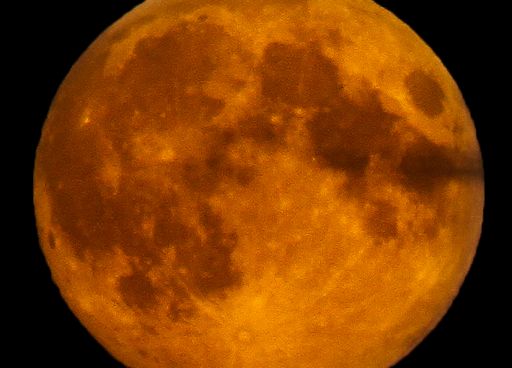
"It was a very beautiful moonrise!" he says.
The name "Harvest Moon" harkens back to a bygone era. Before the days of electric lights, farmers relied on moonlight to harvest crops which ripened all at once in autumn. They couldn't afford to stop working at sunset, so "harvest moonlight" was essential to their operations. The flow of electricity has made the Moon obsolete as a source of practical illumination, but not as an object of beauty. Step outside tonight at sunset, look east and enjoy the view.
Realtime Space Weather Photo Gallery
CHANCE OF FLARES: NOAA forecasters have raised the odds of an X-class solar flare today to 30%. Two sunspots turning toward Earth pose a threat for such eruptions: AR2157 and AR2158. Both are capable of strong geoeffective activity. Solar flare alerts: text, voice
ASTEROID FLIES BY EARTH: On Sunday, Sept. 7th, house-sized asteroid 2014 RC flew past Earth. There was no danger of a collision, but the space rock was close. It sailed just underneath Earth's belt of geeosynchronous satellites and about 40,000 km over New Zealand. Using robotic telescope in Australia, a team of astronomers led by Ernesto Guido photographed 2014 RC zipping through the southern constellation Phoenix at 10 km/s (22,000 mph):
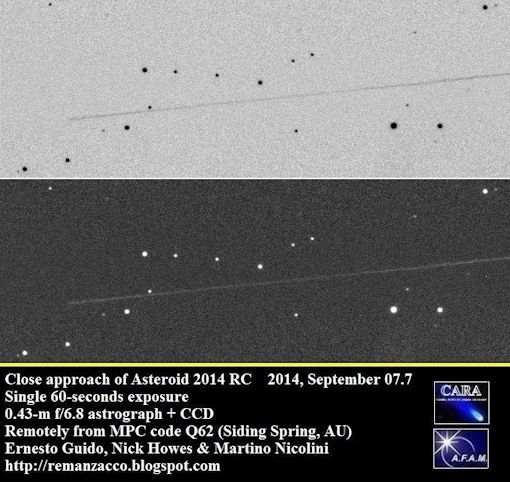
2014 RC came from the asteroid belt just beyond the orbit of Mars. According to NASA, "2014 RC will return to our planet's neighborhood in the future. The asteroid's future motion will be closely monitored, but no future threatening Earth encounters have been identified." [ephemeris] [3D orbit]
MORE ASTEROID NEWS: Now that 2014 RC has passed, another even weirder asteroid is approaching Earth's neighborhood. 2002 CE26 is a binary asteroid consisiting of a primary space rock 3.5 km in diameter and a secondary approximately one-tenth as wide. What's weird is, radar data suggest that the secondary space rock might have a moon of its own. Alberto Quijano Vodniza of the University of Narino Observatory in Colombia photographed the triple system streaking through the constellation Pegasus on Sept. 2nd:

At closest approach on Sept. 9th, 2002 CE26 will be 18.4 million km (0.123 AU) from Earth. That is relatively far away, but because of the asteroid's large size, it is still possible to obtain meaningful data from the flyby. NASA astronomers will be pinging the system using the Goldstone radar in the Mojave desert. The Goldstone team says "we should be able to get coarse-resolution images of the primary. Echoes from the secondary will be weak and on the edge of detectability."
They also encourage experienced amateur astronomers to monitor the flyby: "This object should reach 14th magnitude while at favorable solar elongations, so it should be an excellent target for lightcurves. Lightcurves might detect the signature of at least one satellite and could help refine the orbital period." [3D orbit] [ephemeris]