QUIET WEEKEND: Although the sun is peppered with spots, not one them has the type of complex magnetic field that harbors energy for strong explosions. NOAA forecasters estimate a slight 20% chance of M-class solar flares during what should be a quiet weekend. Solar flare alerts: text, voice
AURORAS LOVE EQUINOXES: On Sept. 23th the sun will cross the celestial equator heading south, marking the end of northern summer. That's good news for high-latitude sky watchers because, for reasons researchers do not fully understand, auroras love equinoxes. At this time of year when the seasons are changing, even gentle gusts of solar wind can spark a nice display of Northern Lights:

Harald Albrigtsen took the picture on Sept. 19th from Kvaløya, Norway. There was no geomagnetic storm predicted that night, and indeed no CME struck our planet. Instead a relatively minor fluctuation in the magnetic orientation of the solar wind sparked the display.
NOAA forecasters estimate a 30% chance of polar geomagnetic storms on Sept 21st, and the probability of Arctic auroras is probably even higher than that. Stay tuned to the realtime photo gallery for sightings. Aurora alerts: text, voice
FIERY SUNSET: Sky watchers in parts of California are finding that, suddenly, they can view sunspots without a solar telescope. Smoke from the epic King Fire is providing a natural filter. David Wheat photographed the fiery sunset from Tuolumne CA:
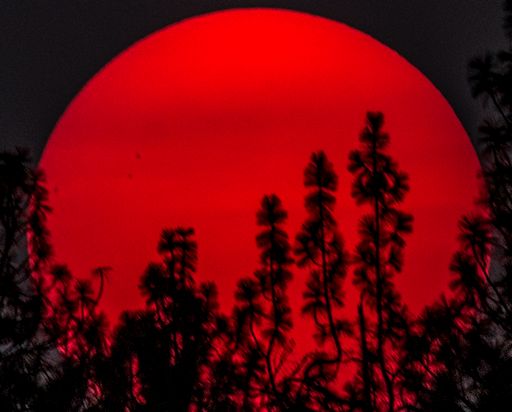
"Notice the 3 sunspots on the upper left of the solar disk " points out Wheat.
The fire, which began a week ago in a canyon east of Sacramento, has ballooned in size to 80,000 acres, larger than the city of Portland. Dense smoke has grounded planes and choked the air for hundreds of miles around the blaze--including a Sierra peak where the headquarters of Spaceweather.com is located. Because the fire is only 10% contained, fiery sunsets will likely continue for days to come.
Warning: Even when the sun is dimmed by smoke and low-hanging clouds, do not look at the sun through magnifying optics. Severe eye damage could result. If you are photographing the sunset, use your camera's digital viewscreen to frame the scene, not the camera's optical viewfinder.
STUDENTS MEASURE 'FORBUSH DECREASE': On Sept. 12th, a CME hit Earth's magnetic field, igniting the most intense geomagnetic storm of the year. The students of Earth to Sky Calculus quickly launched a helium balloon to the stratosphere to see what effect the storm was having on Earth's upper atmosphere. They expected to measure more radiation than usual. Instead, they measured less. This plot shows a sharp drop in high-energy radiation on Sept. 12th compared to previous flights in May, June, and August:

What caused this counterintuitive drop? Answer: When the CME swept past Earth, it swept aside many of the cosmic rays that normally surround our planet. The effect is called a "Forbush Decrease," named after physicist Scott E. Forbush who first described it in the 20th century.
Wherever CMEs go, cosmic rays are deflected by magnetic fields inside the CME. Forbush decreases have been observed on Earth and in Earth orbit onboard Mir and the ISS. The Pioneer 10 and 11 and Voyager 1 and 2 spacecraft have experienced them, too, beyond the orbit of Neptune. Now high school students have detected a Forbush Decrease in the stratosphere using little more than an insulated lunchbox and a helium balloon.
The balloon's lunchbox-payload is shown here suspended more than 100,000 feet above the Sierras of central California:

Inside the payload, there was an ionizing radiation sensor (energy range: 10.0 KeV to 20.0 MeV), a cryogenic thermometer, multiple GPS altimeters and trackers, and three cameras. During the 2.5 hour flight, the buoy collected more than 50 gigabytes of video and science data ranging in altitude from 8500 ft to 113,700 ft above sea level. The analysis is still underway.
The students wish to thank Caisson Biotech LLC for sponsoring this flight. Note their logo on the upper right corner of the payload!
Readers, if you would like to sponsor an upcoming balloon launch and have your logo flown to the edge of space, please contact Dr. Tony Phillips to make arrangements. The cost of sponsorship is $500. Sponsors receive a complete video of the flight along with advertising exposure on spaceweather.com.
Realtime Space Weather Photo Gallery