AUTUMNAL EQUINOX: Today, Sept. 23rd at 0229 UT, the sun crossed the celestial equator heading south. The crossing marks the beginning of fall in the northern hemisphere--a.k.a. the autumnal equinox. Equinox means equal night. With the sun near the celestial equator, we experience equal amounts of daylight and darkness, 12 hours of each. Aurora alerts: text, voice
AURORA SEASON: The beginning of northern autumn is good news for sky watchers: It's also the beginning of aurora season. For reasons researchers do not fully understand, geomagnetic storms happen most often around the time of equinoxes. Last night, just as the sun was crossing the celestial equator, auroras exploded through the clouds over Sortland, Norway:
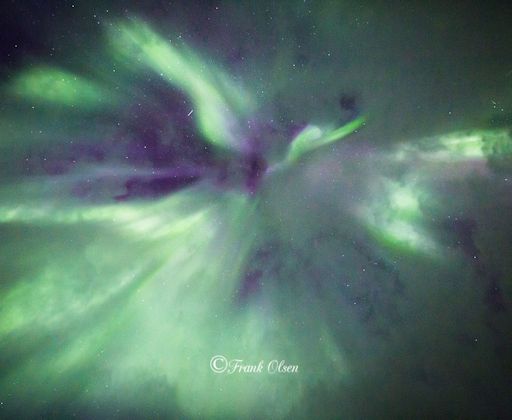
"There were no auroras in the forecast," says photographer Frank Olsen, "but I decided to head out anyway. As soon as it was dark enough there was quite a show."
Olsen's story is typical of autumn in the Arctic. The forecast calls for no auroras, but a gentle gust of solar wind produces some anyway. Mindful of the season, NOAA forecasters estimate a 40% chance of polar geomagnetic storms on Sept. 23rd as a minor stream of solar wind blows around Earth. Aurora alerts: text, voice
BROODING GIANT: Solar activity is low. However, new sunspot AR2172 threatens to break the quiet. Karzaman Ahmad photographed the behemoth active region on Sept. 22nd from the Langkawi National Observatory in Maylasia:
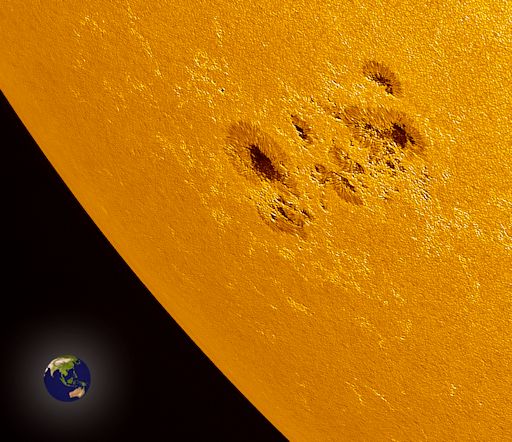
The sunspot's primary dark cores are nearly as wide as Earth, and the entire group stretches more than 80,000 km from end to end. These dimensions make AR2172 an easy target for small solar telescopes. "I took the picture using an 11-inch telescope," says Ahmad.
Yesterday, for a while, the sunspot's magnetic field displayed an unstable mixture of polarities that harbored energy for strong explosions. Now the threat has subsided. As the situation shifts back and forth, NOAA forcasters estimate a 30% chance of M-class flares and a 5% chance of X-flares on Sept. 23rd. Solar flare alerts: text, voice
Realtime Space Weather Photo Gallery
STUDENTS MEASURE 'FORBUSH DECREASE': On Sept. 12th, a CME hit Earth's magnetic field, igniting the most intense geomagnetic storm of the year. The students of Earth to Sky Calculus quickly launched a helium balloon to the stratosphere to see what effect the storm was having on Earth's upper atmosphere. They expected to measure more radiation than usual. Instead, they measured less. This plot shows a sharp drop in high-energy radiation on Sept. 12th compared to previous flights in May, June, and August:

What caused this counterintuitive drop? Answer: When the CME swept past Earth, it swept aside many of the cosmic rays that normally surround our planet. The effect is called a "Forbush Decrease," named after physicist Scott E. Forbush who first described it in the 20th century.
Wherever CMEs go, cosmic rays are deflected by magnetic fields inside the CME. Forbush decreases have been observed on Earth and in Earth orbit onboard Mir and the ISS. The Pioneer 10 and 11 and Voyager 1 and 2 spacecraft have experienced them, too, beyond the orbit of Neptune. Now high school students have detected a Forbush Decrease in the stratosphere using little more than an insulated lunchbox and a helium balloon.
The balloon's lunchbox-payload is shown here suspended more than 100,000 feet above the Sierras of central California:

Inside the payload, there was an ionizing radiation sensor (energy range: 10.0 KeV to 20.0 MeV), a cryogenic thermometer, multiple GPS altimeters and trackers, and three cameras. During the 2.5 hour flight, the buoy collected more than 50 gigabytes of video and science data ranging in altitude from 8500 ft to 113,700 ft above sea level. The analysis is still underway.
The students wish to thank Caisson Biotech LLC for sponsoring this flight. Note their logo on the upper right corner of the payload!
Readers, if you would like to sponsor an upcoming balloon launch and have your logo flown to the edge of space, please contact Dr. Tony Phillips to make arrangements. The cost of sponsorship is $500. Sponsors receive a complete video of the flight along with advertising exposure on spaceweather.com.
Realtime Space Weather Photo Gallery