CONGRATULATIONS TO INDIA: Mars is a notoriously risky planet to visit. Of 51 spacecraft sent to the Red Planet by the USA, Europe and Russia, only 21 have successfully entered orbit and/or landed. India joined that exclusive club today--and the newly spacefaring nation did it on the first try. At 7:30 AM India time on Sept. 24th, the Mars Orbiter Mission--a.k.a. "MOM"--entered orbit around Mars. Instruments onboard MOM will study the make-up of the Martian atmosphere and measure the abundance of methane, a possible marker of biological activity. Congratulations to India!
GEOMAGNETIC UNREST: Today, the interplanetary magnetic field (IMF) near Earth is tilting south, not much, but enough to open a crack in Earth's magnetosphere. Solar wind is pouring through the opening to fuel polar auroras. Among many beautiful examples in the aurora gallery, this photo gets front-page treatment because it captures a rare "fireball reflection" in the waves beneath beneath the lights:
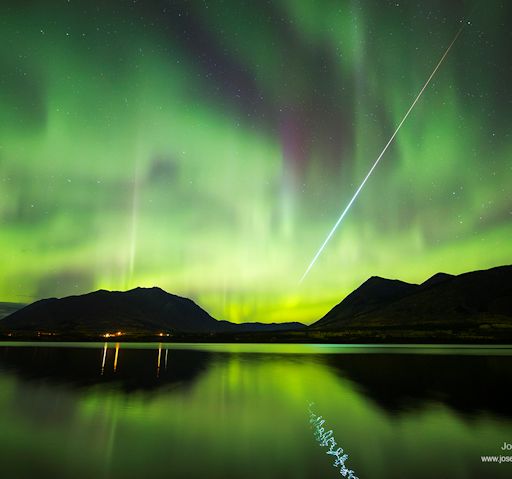
"Northern Lights were all over the sky... then WOW! A meteor streaked through the frame," says photographer Joseph Bradley of Carcross, Yukon. "it was so bright it even cast a reflection in the water. I will never forget how beautiful it was. I thought it was going to hit the ground and at the last moment it broke up. It was a great event!"
So far, the solar wind disturbance is causing merely "geomagnetic unrest." NOAA forecasters estimate a 40% chance that a full-fledged geomagnetic storm could develop in the next 24 hours. Polar sky watchers should remain alert for auroras. Aurora alerts: text, voice
EQUINOX SOLAR FLARE: Northern autumn began with a bang, albeit only a medium-sized one. Big sunspot AR2172 erupted on Sept. 23rd at 2316 UT, producing an impulsive M2-class solar flare, shown here in a movie recorded by NASA's Solar Dynamics Observatory:
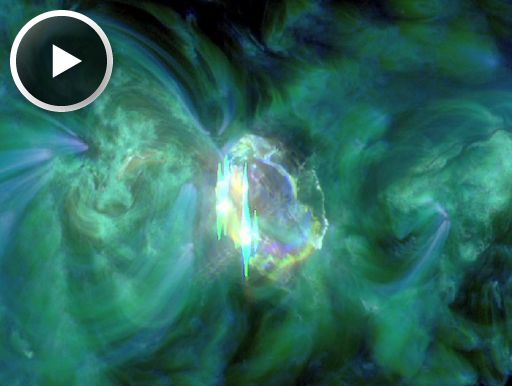
Update: Just-arriving data from SOHO coronagraphs show that the explosion did indeed produce a faint CME. Analysts are woring now to determine if the cloud has an Earth-directed component. Stay tuned.
Meanwhile, more flares are in the offing. AR2172 continues to grow and it has a 'beta-gamma' magnetic field that harbors energy for strong explosions. NOAA forcasters estimate a 30% chance of M-class flares and a 5% chance of X-flares on Sept. 24th. Solar flare alerts: text, voice
Realtime Space Weather Photo Gallery
MARS vs. ANTI-MARS: Shining bright red in the heart of the constellation Scorpius, 1st-magnitude star Antares is often mistaken for Mars. In Greek, "Antares" means "rival of Mars" or "anti-Mars," so-named because it is about the same brightness and color as the Red Planet. As September comes to a close, the rivals are converging. Jeff Dai sends this photo of Mars and Antares setting side-by-side behind Mount Balang in Sichuan, China:
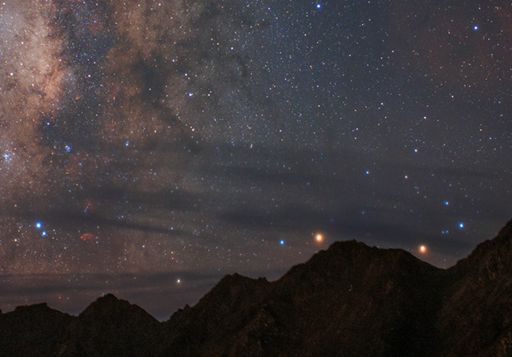
"I was looking southwest in the evening sky on Sept. 20th when a conspicuous pair of ruddy objects grabbed my attention," says Dai. "Red planet Mars is moving in for a close encounter with its ancient rival, the red supergiant star Antares."
On Sept. 28th and 29th, the nights of closest approach, Mars and Antares will be only a few degrees apart, a conjunction tight enough to fit behind your outstretched palm. Sept. 29th is the best night to look because the Moon will join the display, lining up to form a near-vertical column of heavenly bodies just above the southwestern horizon. Sept. 27th is a good night, too, but for a different reason: A slender crescent Moon will pass very close to Saturn not far from Antares and Mars. Sky maps: Sept. 25, 26, 27, 28, 29.


Can't remember all these dates? Let Spaceweather.com do the remembering for you. Sign up for backyard astronomy alerts.
Realtime Space Weather Photo Gallery