FAST-GROWNG SUNSPOT: New sunspot AR2175 didn't exist one day ago. Now it stretches more than 100,000 km across the face of the sun with a primary dark core larger than Earth. The fast-growing region has a 'beta-gamma' magnetic field that harbors energy for M-class solar flares. Solar flare alerts: text, voice


FIRST LIGHT FOR MAVEN: A key goal of NASA's MAVEN spacecraft is to learn how space weather affects the upper atmosphere of Mars. Just days after MAVEN reached the Red Planet, the data are starting to flow. "Our Imaging Ultraviolet Spectrograph (IUVS) instrument obtained these false-color images of Mars on Sept. 22nd," says Nick Schneider who leads the IUVS team at the University of Colorado. "They trace the distribution of two important gases, hydrogen and oxygen."

Image credit: Laboratory for Atmospheric and Space Physics, U. Colorado; NASA
"The oxygen gas is held close to the planet by Mars's gravity, while lighter hydrogen gas expands to higher altitudes and extends past the edges of the image," he explains. "These gases come from the breakdown of water and carbon dioxide in Mars's atmosphere."
Billions of years ago, Mars was blanketed an atmosphere massive enough to warm the planet and allow liquid water to flow on its surface. Today, only a tiny fraction of that ancient air remains. Where did it go? One possibility is space weather: Solar storms and the relentless buffeting of solar wind might have stripped away much of the planet's gaseous envelope.
The IUVS might be able to see this process in action--especially in the aftermath of a CME strike. "We expect to see something!" says Schneider. "MAVEN's primary science goal is to see how the atmosphere responds to solar forcing. So on the one hand, a CME might strip way the outermost layers of the atmosphere. On the other, it might also energize the atmosphere below and repopulate the extended atmosphere with a lot of new material." Either way, IUVS can observe what happens.
The instrument is also capable of observing martian auroras. "We're on the edges of our seats, hoping for our first detection," he says. Stay tuned!
AURORA SEASON: How do you know it's autumn in Iceland? It's when the icebergs turn green. Last night, Steve Lansdell photographed the phenomenon from the Jokulsaron Ice Lagoon:
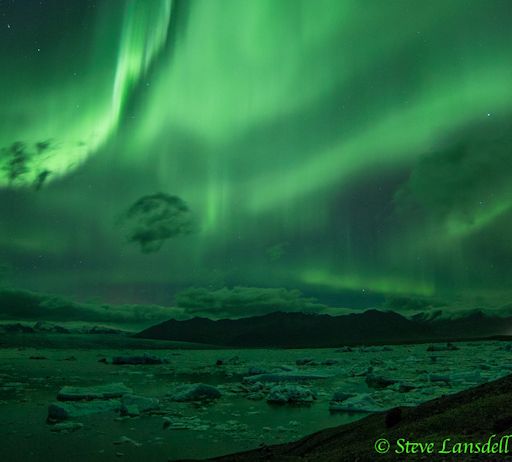
"We've seen auroras 4 nights in a row, but last night was really spectacular," says Lansdell. "The green lit up the icebergs in a wonderful display that thrilled my friends."
These are equinox auroras, appearing less than 48 hours after the onset of northern autumn. For reasons researchers don't fully understand, auroras love equinoxes. At this time of year even a gentle gust of solar wind can spark a beautiful display. Mindful of the season, NOAA forecasters estimate a 50% chance of more polar geomagnetic storms--and more green ice--in the next 24 hours. Aurora alerts: text, voice
MARS vs. ANTI-MARS: Shining bright red in the heart of the constellation Scorpius, 1st-magnitude star Antares is often mistaken for Mars. In Greek, "Antares" means "rival of Mars" or "anti-Mars," so-named because it is about the same brightness and color as the Red Planet. As September comes to a close, the rivals are converging. Jeff Dai sends this photo of Mars and Antares setting side-by-side behind Mount Balang in Sichuan, China:
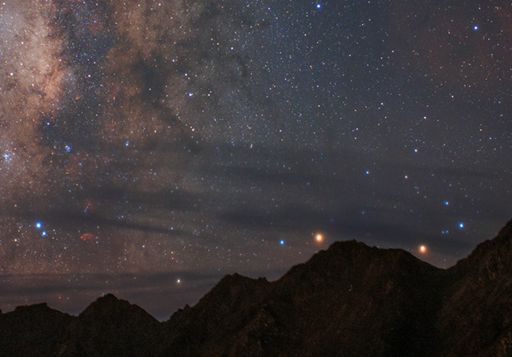
"I was looking southwest in the evening sky on Sept. 20th when a conspicuous pair of ruddy objects grabbed my attention," says Dai. "Red planet Mars is moving in for a close encounter with its ancient rival, the red supergiant star Antares."
On Sept. 28th and 29th, the nights of closest approach, Mars and Antares will be only a few degrees apart, a conjunction tight enough to fit behind your outstretched palm. Sept. 29th is the best night to look because the Moon will join the display, lining up to form a near-vertical column of heavenly bodies just above the southwestern horizon. Sept. 27th is a good night, too, but for a different reason: A slender crescent Moon will pass very close to Saturn not far from Antares and Mars. Sky maps: Sept. 25, 26, 27, 28, 29.


Can't remember all these dates? Let Spaceweather.com do the remembering for you. Sign up for backyard astronomy alerts.
Realtime Space Weather Photo Gallery