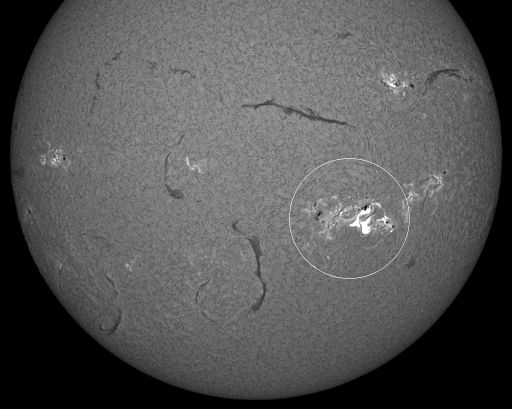
SOLAR FLARE: Weekend fireworks were predicted, and the sun complied. On Sunday, Sept. 28th (0258 UT), the magnetic canopy of sunspot AR2173 erupted, producing an M5-class solar flare. The sun was high overhead in Australia when Matt Wastell of Brisbane photographed the explosion:
Extreme UV radiation from the flare ionized the top of Earth's atmosphere, disturbing the normal propagation of radio transmissions around our planet. In particular, there was a limited blackout of HF radio communications and a probable loss of shortwave radio contact in daylit areas for some tens of minutes.
At the moment, we do not know if this explosion hurled a coronal mass ejection (CME) toward Earth. Based on the impulsiveness (brevity) of the flare, we think not. A final answer awaits coronagraph data from the SOHO and STEREO spacecraft.
Wastell's picture, which he took using a solar telescope tuned to the red glow of solar hydrogen, shows more than a half-dozen dark magnetic filaments winding across the face of the sun. Like sunspots, these filaments pose a threat for flares. When a magnetic filament collapses it can hit the stellar surface and explode, causing a type of "spotless" explosion called a Hyder flare.
Taking into account all of the sunspots as well as the filaments, NOAA forecasters estimate a 65% chance of M-class flares and a 10% chance of X-flares in the next 24 hours. Solar flare alerts: text, voice
Realtime Space Weather Photo Gallery
MEANWHILE IN THE SOUTHERN HEMISPHERE: While much attention is being paid to the fact that September's equinox kicked off aurora season in the Northern Hemisphere, we should not forget that the Southern Hemisphere has just experienced the exact same equinox. It is aurora season there, too. Petr Horálek sends this example of Southern Lights over Lauder, New Zealand, on Sept 25th:
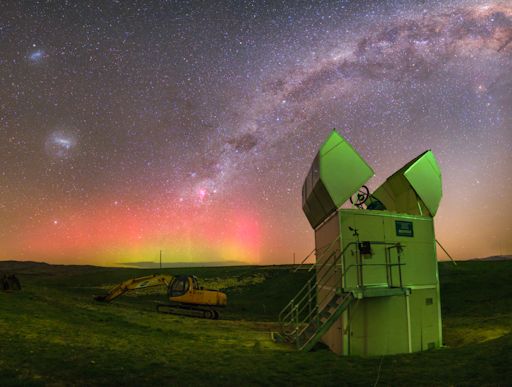
"The auroras burned very low above the southern horizon here at the NIWA atmospheric research station," Horálek says. "The opened dome is the BOOTES telescope, which is used to detect the optical afterglow of distant gamma-ray bursts. A green lidar behind me reflected from the dome, giving it a green hue."
For reasons researchers do not fully understand, at this time of year even gentle gusts of solar wind can ignite beautiful auroras. Right now Earth is passing through a minor stream of solar wind that has both poles aglow. Browse the realtime aurora gallery for sightings. Aurora alerts: text, voice
MARS vs. ANTI-MARS: Shining bright red in the heart of the constellation Scorpius, 1st-magnitude star Antares is often mistaken for Mars. In Greek, "Antares" means "rival of Mars" or "anti-Mars," so-named because it is about the same brightness and color as the Red Planet. As September comes to a close, the rivals are converging. Jeff Dai sends this photo of Mars and Antares setting side-by-side behind Mount Balang in Sichuan, China:
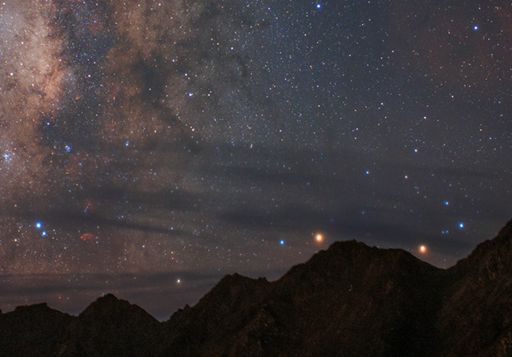
"I was looking southwest in the evening sky on Sept. 20th when a conspicuous pair of ruddy objects grabbed my attention," says Dai. "Red planet Mars is moving in for a close encounter with its ancient rival, the red supergiant star Antares."
On Sept. 28th and 29th, the nights of closest approach, Mars and Antares will be only a few degrees apart, a conjunction tight enough to fit behind your outstretched palm. Sept. 29th is the best night to look because the Moon will join the display, lining up to form a near-vertical column of heavenly bodies just above the southwestern horizon. Sept. 27th is a good night, too, but for a different reason: A slender crescent Moon will pass very close to Saturn not far from Antares and Mars. Sky maps: Sept. 25, 26, 27, 28, 29.


Can't remember all these dates? Let Spaceweather.com do the remembering for you. Sign up for backyard astronomy alerts.