INCREASING CHANCE OF FLARES: There are now four sunspot groups on the solar disk with unstable magnetic fields, which means an eruption today is likely. NOAA forecasters have raised the daily odds of an M-class solar flare to 75% and an X-flare to 15%. Solar flare alerts: text, voice
EVENING SKY SHOW: When the sun ges down tonight, step outside and look southwest. Mars, Antares and the crescent Moon have lined up to form a near-vertical column of heavenly bodies just above the horizon. Last night, Alan Dyer photographed the trio converging over Cluny, Alberta, Canada:

"It was a beautiful crisp autumn evening for watching the twilight show of the waxing Moon and the pairing of Mars and his rival red star, Antares," says Dyer. " I shot this image as part of a time-lapse sequence overlooking the Bow River in southern Alberta."
As the twilight sky fades to black, pay special attention to the visual appearance of Mars and Antares. They are nearly identical. In Greek, "Antares" means "rival of Mars" or "anti-Mars," so-named because it is about the same brightness and color as the Red Planet. Seeing the two side-by-side as their ruddy light beams through the darkening cobalt sky is a rare pleasure. Sky maps: Sept. 28, 29.


Realtime Space Weather Photo Gallery
IN SEARCH OF THE FORBUSH REBOUND: On Sept. 12th a CME hit Earth head-on, sparking the strongest geomagnetic storm of the year. Using a helium balloon, the students of Earth to Sky Calculus launched a Space Weather Buoy into the storm, expecting to measure an increase in energetic particles. Instead of more, however, they measured less. The CME swept away many of the cosmic rays around Earth and, as a result, radiation levels in the stratosphere dropped. This counterintuitive effect is called a "Forbush Decrease" after the 20th century physicist Scott Forbush who first described it.
Now that the CME is long gone, cosmic radiation levels around Earth should be returning to normal. Yesterday, Sept. 28th, the students launched another buoy in search of the "Forbush Rebound."

In the photo, above, an Earth to Sky student holds the payload, which contains a gamma-ray sensor, a cryogenic thermometer, multiple GPS trackers and altimeters, three video cameras, and an astrobiology experiment. The balloon, inset, was launched at 10:30 a.m. PDT from the Sierra Nevada mountains of central California.
It appears that the mission was a success. During a three-hour flight, the balloon ascended to the stratosphere, sampling radiation between ground level and approximately 115,000 ft. The payload then parachuted back to Earth and landed in a remote area of Death Valley National Park. A team of students and Dr. Tony Phillips will recover the sensors on Tuesday, Sept. 30th. Stay tuned for results.
Note: The students wish to thank Sander Geophysics for sponsoring this flight. Their generous contribution of $500 paid for the helium and other supplies necessary to get this research off the ground.
Realtime Space Weather Photo Gallery
MEANWHILE IN THE SOUTHERN HEMISPHERE: While much attention is being paid to the fact that September's equinox kicked off aurora season in the Northern Hemisphere, we should not forget that the Southern Hemisphere has just experienced the exact same equinox. It is aurora season there, too. Petr Horálek sends this example of Southern Lights over Lauder, New Zealand, on Sept 25th:
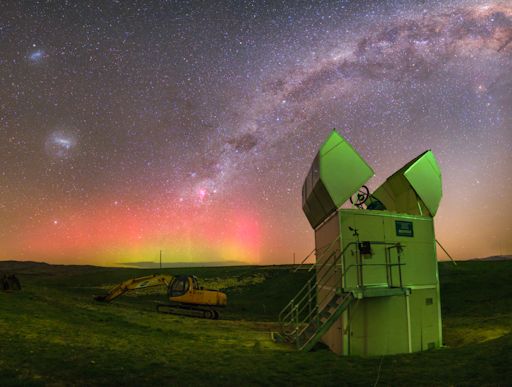
"The auroras burned very low above the southern horizon here at the NIWA atmospheric research station," Horálek says. "The opened dome is the BOOTES telescope, which is used to detect the optical afterglow of distant gamma-ray bursts. A green lidar behind me reflected from the dome, giving it a green hue."
For reasons researchers do not fully understand, at this time of year even gentle gusts of solar wind can ignite beautiful auroras. Right now Earth is passing through a minor stream of solar wind that has both poles aglow. Browse the realtime aurora gallery for sightings. Aurora alerts: text, voice