SPACE WEATHER BUOY LANDS IN DEATH VALLEY: A space weather buoy launched on Sept. 28th to measure radiation levels in the stratosphere has landed in a remote area of California's Death Valley National Park. Students from Earth to Sky Calculus are en route to the payload now. Earlier this month a CME swept away many of the cosmic rays that normally surround our planet, causing a drop in stratospheric radiation. The goal of the Sept. 28th flight was to measure the recovery. Has the stratosphere returned to normal? Stay tuned for answers.
GEOMAGNETIC UNREST: Earth's polar magnetic field is unsettled, causing polar skies to turn green. "For the third time in four days our group experienced a light show that was out of this world," reports aurora tour guide Chad Blakley from Sweden's Abisko National Park. "Last night, after several hours of stormy weather the clouds parted like curtains on a stage allowing us to see some of the strongest auroras of the season."
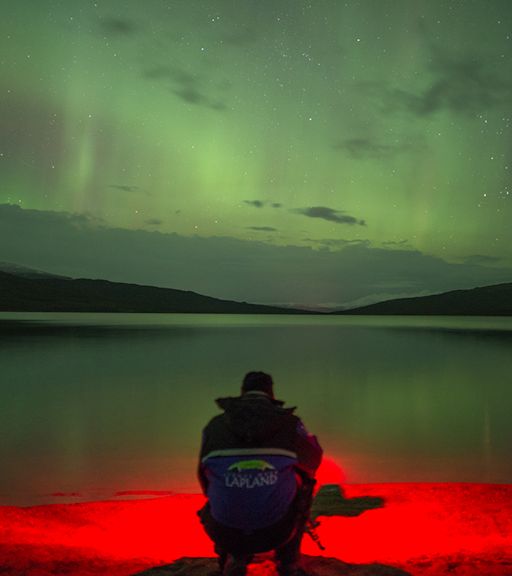
The ongoing display is a result of our planet's response to the interplanetary magnetic field (IMF). The IMF has tipped south, slightly, just enough to open a crack in Earth's magnetosphere. Solar wind is leaking in to fuel the auroras.
"If the next six months are anything like September we are going to have an amazing aurora season," says Blakely.
The nights ahead could be amazing too. NOAA forecasters estimate a 35% to 40% chance of polar geomagnetic storms from Sept. 30th through Oct. 2nd. Monitor the aurora gallery for sightings. Aurora alerts: text, voice
CHANCE OF FLARES: There are eight sunspot groups on the Earthside of the sun. Fully half of them pose a threat for strong solar flares. An eruption today could come from any of the circled regions:

AR2175 is the most potent of the quartet. It has a 'beta-gamma-delta' magnetic field that harbors energy for X-class solar flares. The other three have "beta-gamma" magnetic fields that pose a threat for lesser albeit still powerful M-flares.
The sunspot of greatest interest is AR2177 because it is turning toward Earth. Karzaman Ahmad of the Langkawi National Observatory in Maylaysia captured the sunspot group, seething with low-level activity, in this dramatic starscape on Sept. 30th:
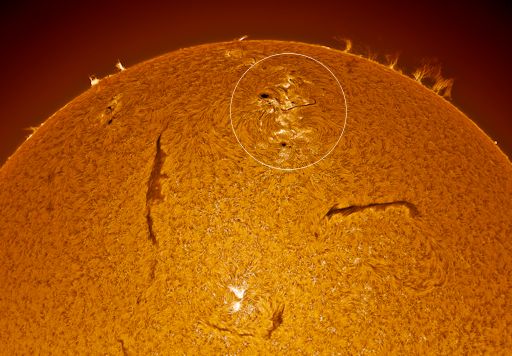
Any eruptions from AR2177 in the days ahead will almost surely be geoeffective.
Mindful of the multiple flare threats, NOAA forecasters say an eruption is likely. They estimate a 75% chance of M-flares and a 20% chance of X-flares on Sept. 30th. Solar flare alerts: text, voice
Realtime Space Weather Photo Gallery