LESS QUIET, MORE FLARES: Sunspot AR2181 is growing and beginning to crackle with impulsive M-class solar flares. This development could break several days of quiet on the sun and lead to a more active weekend. Solar flare alerts: text, voice
LUNAR ECLIPSE RECORDED BY SOLAR ARRAY: During a lunar eclipse, the normally-bright full Moon darkens as it passes through the shadow of Earth. Millions of sky watchers witnessed this beautiful dimming on Oct. 8th. David Boatwright of Californiia experienced the eclipse in a different way. His solar array browned out:

"My home has a 4.5 kW photovoltaic solar system on its roof," he explains. "During the day it produces a good amount of electricity. It even produces a couple of volts from ambient light at night. A full Moon will increase it to nearly 4 volts DC when overhead."
"Pictured above is a screen shot of the power output from my system. As you can see, it recorded the lunar eclipse. The voltage was cut in half during totality. From 3:30am to 4:30am PDT, the DC voltage dropped from 4 volts to 2 volts and then back up to 3volts at the conclusion of the eclipse. I believe the 1 volt difference, before vs. after the eclipse, is due to the Moon being lower in the sky when the eclipse ended."
"By the way, I was watching the eclipse in my backyard as this voltage drop was occurring," he says.
Realtime Eclipse Photo Gallery
PICK THE WINDOW SEAT: At this time of year, only a few weeks after the aurora-loving equinox, Northern Lights are almost always visible somewhere around the Arctic Circle. "Last night I was flying to Europe from Calgary and I strategically selected the window seat hoping for a show," reports traveler Christy Turner. This is what she saw:
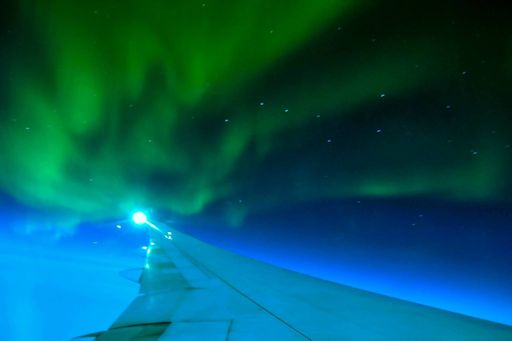
"Boy did I luck out!" she says. Indeed she did. During her flight, the interplanetary magnetic field (IMF) around Earth tipped south. South-pointing IMFs open a crack in Earth's magnetosphere, allowing solar wind to pour through and ignite auroras.
Will it happen again tonight? NOAA forecasters estimate a 20% chance of polar geomagnetic storms--good enough odds to pick the window seat. Aurora alerts: text, voice
COLORFUL LUNAR ECLIPSE: Lunar eclipses are supposed to be red. Yesterday's eclipse had an extra dash of turquoise. "The colors on this eclipsed moon were more varied and vivid than any in memory -- maybe because it stayed so close to the edge of the shadow for the duration of the eclipse," reports astronomy professor Jimmy Westlake, who sends this picture from Stagecoach, Colorado:

"Nearly every color of the rainbow appeared on the Moon just before the end of totality," he says.
Atmospheric scientist Richard Keen of the University of Colorado explains the colors: "During a lunar eclipse, most of the light illuminating the Moon passes through Earth's stratosphere where it is reddened by scattering. However, light passing through the upper stratosphere penetrates the ozone layer, which absorbs red light and actually makes the passing light ray bluer." This can be seen, he says, as a soft blue fringe around the red core of Earth's shadow--colors which are reflected from the surface of the Moon.
Visit the realtime photo gallery for more colorful snapshots of the Oct. 8th lunar eclipse.
Realtime Eclipse Photo Gallery
Realtime Space Weather Photo Gallery