SOLAR SECTOR BOUNDARY CROSSING: High-latitude auroras are possible on Oct. 14th when Earth crosses through a fold in the heliospheric current sheet. This is called a "solar sector boundary crossing," and NOAA forecasters estimate a 25% chance of polar geomagnetic storms when it occurs. Aurora alerts: text, voice
RE-WRITE THE TEXTBOOKS: Look up at the Moon. The surface of Earth's satellite never seems to change. Indeed, planetary scientists have long thought that lunar volcanism came to an abrupt end about a billion years ago, and little has changed since. On Oct. 12th, NASA announced evidence to the contrary. A camera onboard the Lunar Reconnaissance Orbiter (LRO) has found signs of eruptions that occurred no more than 100 million years ago:

100 million years may sound like a long time, but in geological terms it's just a blink of an eye. The volcanic craters LRO found were erupting during the Cretaceous period--the heyday of dinosaurs. Some of the volcanic features may be even younger, 50 million years old, a time when mammals were replacing dinosaurs as dominant lifeforms.
"This finding is the kind of science that is literally going to make geologists rewrite the textbooks about the Moon," said John Keller, LRO project scientist at the Goddard Space Flight Center."
Using its high-resolution camera, LRO has found scores of these geologically "fresh" eruptions. The features are too small to be seen from Earth, averaging less than a third of a mile (500 meters) across in their largest dimension, but they appear to be widespread.
"These young volcanic features are prime targets for future exploration, both robotic and human," said Mark Robinson, principal investigator for the Lunar Reconnaissance Orbiter Camera (LROC) at Arizona State University.
Realtime Space Weather Photo Gallery
ORIONID METEOR SHOWER: On the night of Oct. 12th, NASA's All-Sky Meteor Network detected a piece of Halley's Comet disintegrating in the atmosphere over New Mexico. The fireball was bright enough to see through the light of a bright gibbous Moon:
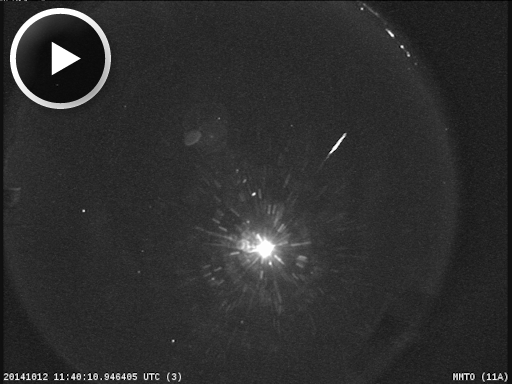
Multiple cameras tracked the meteoroid, which allowed a calculation of its trajectory: It hit Earth's atmosphere traveling 68 km/s (152,000 mph) and fully disintegrated 67.9 km above Earth's surface.
This fireball is a sign that the Orionid meteor shower is about to begin. Every year in mid- to late-October, Earth passes through a stream of debris from Halley's Comet, the parent of the Orionids. For many nights in a row, pre-dawn sky watchers can see meteors streaking out of the constellation Orion, near the Hunter's shoulder. In 2014, forecasters expect the Orionids to peak on Oct. 21-22 with 20 to 25 meteors per hour.
Stay tuned for updates about meteor activity as Earth approaches the heart of the debris stream. Meteor alerts: text, voiceRealtime Space Weather Photo Gallery
FALL COLORS: In most places, the colors of autumn are golden yellow and red, the palette of trees preparing for winter. In Norway, the colors of autumn are different: green and white--that is, auroras over ice. Bernt Olsen photographed them both on Oct. 11th:
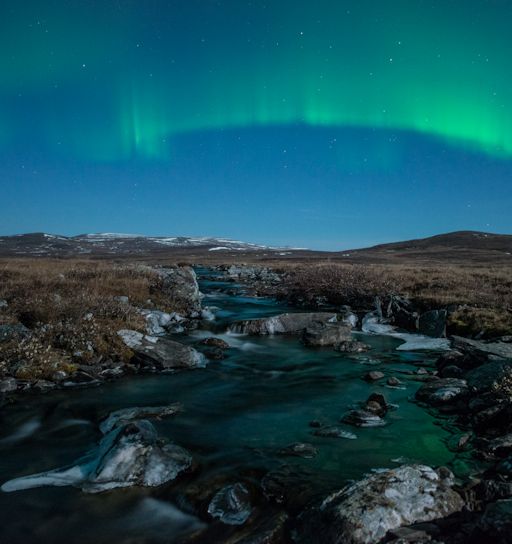
"High up in the Norwegian mountains, at Goulasjavri, close to the Finnish border, the auroras were visible through bright moonlight," says Olsen. "I was able to take the picture despite a cold freezing wind." Aurora alerts: text, voice
Realtime Eclipse Photo Gallery